keskiviikko 2. maaliskuuta 2016

Bentham: Introduction to the Principles of Morals and Legislation (1789)

Jeremy Bentham (1747-1832)

Morals and jurisprudence are quite a different thing, one might imagine, and indeed, at least after Kant and his definite separation of the two, this might well be true. Yet, one must not forget that Kant's division of these disciplines was rooted in a context, in which the two were thought to be intimately connected. Before Kant, one might read books about natural law, which was the ground and basis of both jurisprudence and morals – natural law, ordained by God or reason or nature or all of them, was an ideal that all civil laws should follow, even though they might add some more laws to keep the wheels of civil society running and even though natural law demanded things that no civil authority had the power to control. Indeed, one might even think that Kant himself did not distance himself too far from that context, although he made a far sharper distinction between the two disciplines than earlier philosophers.

Thus, it is no wonder then that Bentham wants to introduce at common principle for both morals and jurisprudence. The two disciplines just have different fields of application, Bentham says. Juriprudence deals with behaviour that civil society can control, but when behaviour exceeds those limits, there's only morals to rely on. Bentham is especially speaking of punishments, which was the original topic of the book – if it would be too costly and difficult to apprehend all people taking part in some behaviour conceived unacceptable, then at least moralists can speak against it. Morals become then more like an afterthought or a last minute resort, while the true interest of the book lies in legislation.

Legislation, Bentham says, consists usually of two parts. Well, he admits, there's also the so-called constitution, but this is not clearly important for Bentham. At best, constitution just states who are the people who have the authority to enforce law. At worst, it is just a collection of declarations, which appear to give unrestricted rights to people, which the later law then restricts – people are born free, but then law might demand restrictions on some people's liberties.

The mass of the law consists of expository material and definitions required to understand what the laws are all about – by copyright is meant this and that. The core of the law then consists of imperatives – you should follow the copyright – and for each imperative, there should be a distinct punishment, Bentham says – if you impeach the copyright, you shall be fined. The latter statement might be questioned, at least on some definitions of punishments, because there are laws denying something, but not assigning any punishments. Such laws without punishments might still, for instance, give a law enforcer a right to stop anyone from acting in some manner (cycling around with a helmet is forbidden in such a sense in Finland).

The bulk of Bentham's book consists then of divisions of possible ways of misconduct, which might be forbidden by law. The basic method of classification for Bentham is founded on the fact, who or what set of persons bears the bad consequences of misconduct. Bentham suggests four possibilities: the consequences might affect the person itself, some other individual, some small set of people or the whole community.

What is remarkable in Bentham's division is the fact how little intentionality of the actions bears on identifying something as misconduct. True, some form of intentionality is a necessary condition for something being punishable – a person who drops a stone on the head of a man walking below accidentally or out of ignorance is not culpable. Yet, even the inclusion of certain crimes in his classification shows that intetionality is not a very central concern of Bentham's. For instance, a person who eats and drinks too much might not have any intention of hurting oneself, yet, Bentham considers that it still forms an offence, because one ought to know better and see how bad the consequences are.

A clear criterion for taking some action as bad, for Bentham, is then the set of consequences following from that action. Bentham is here going especially against theories of natural law, in which good and bad actions were decided more by their concordance with some law. Bentham suggests that the real reason guiding these theories is just an antipathy or sympathy one feels towards some actions – philosophers speak about natural law, but actually just reveal their own likes and dislikes. The same criticism appears to go against all deontological theories, which take goodness and badness to be an intrinsic property of actions, despite their consequences. Bentham's attitude appears rather unfair – he doesn't understand what such a theory is all about, thus, he concludes that it is just an arbitrary decision of what is good or bad.

We might briefly consider what Bentham would say to a virtue theory, which bases the essence of ethics to individual's character instead of actions and their consequences. Firstly, it is undoubtedly difficult to base a system of jurisprudence on virtue theory (we don't usually punish people, because of their characters), and as jurisprudence is far more interesting topic to Bentham than ethics, he would have little motive to entertain virtue theory. Furthermore, Bentham appears to think that character is essentially just a fiction describing the tendency of a person to act in certain manner, where the tendency is merely a generalisation out of all past actions of a person.

Bentham is then a devoted consequentialist, and he considers two species of it: either one thinks pleasures are to be sought out and pleasures abandoned or the other way around. The latter principle – the principle of asceticism – is something Bentham ridicules a lot. It is an apparent caricature of Stoic and Christian ideals – surely these two do not aim for pain for its own sake, but for pleasures of a higher sort.

Bentham's preferred theory is then utilitarianism – the worth of an action is decided by the pleasure and the pain it engenders. One must say that there are certain problems in this suggestion, especially when it is applied to jurisprudence. Bentham appears to say that in jurisprudence we should particularly look at the consequences of an action for all citizens of a society. Now, among pleasures and pains Bentham considers are such emotions like security and fear. If then the majority will experience fear and anxiety over some plausible consequences of person's actions, these actions are to be condemned bad. Then again, if a person does not marry a person of another gender and beget children – perhaps because she has vowed herself for abstinence, or perhaps because she would instead want to marry someone of the same gender – this will make the country weaker on the long run, because not as many children are born as could be. Bentham then concludes that sexual relationships incapable of begetting children and even abstinence are both condemnable, even if something where the actual punishment must be left for morals.


I find Bentham's reasoning here somewhat questionable, since its result breaches certain inalienable rights of human beings, namely, their right to determine their own sexuality. Of course, Bentham has already said law shouldn't recognise any inalienable rights, but all things should be guided by the pleasure of the majority, without any concern for the welfare of minorities. Admittedly, this is all quite in line with Bentham's utilitarianism, but this just makes me question, whether utilitarianism, at least in Bentham's style, is a proper principle of either ethics or jurisprudence.

maanantai 4. tammikuuta 2016

Thomas Jefferson (1743-1826)


It is a question raised in recent years, whether liberalism, that supposed liberator of humankind, has actually been tainted with a foul crime to humanity – I am speaking, of course, about the slavery. Many leading liberalist thinkers, like John Locke, wrote in favour of enslavement of black Africans, and especially on the western side of Atlantic, they even owned slaves. This involves a complex line of ideas that I cannot follow here, but the basic question appears to be whether the liberation of one class of humans from traditional restrictions of religious morality and the establishment of first capitalist systems might somehow have worsened the state of the people used by this enlightened persons as their household equipment.

Thomas Jefferson apparently is one of the most contradictory persons in this context: one of the largest slave holder in the country, yet, denied the right to import slaves to United States, yet, did nothing to discourage the local slave trades, yet, did plan on gradual liberation of slaves, yet, held Africans to be inferior to Europeans – a list of paradoxes that just keeps growing. This is an interesting muddle to deal with, but one which I regretfully will have to leave for specialists of Jefferson's thought.

I am now mostly interested in Jefferson's religious ideas, or more precisely, in the way how he suggested religion should be seen in the affairs of state. Of course, his religious ideas as such are also of interest. Apparently, he had constructed his very own version of Gospels, cutting up pieces of life story and sayings of Jesus from all the Gospels and putting it all together into a whole. Particularly, Jefferson had discarded all descriptions of miracles and all suggestions of the divinity of Jesus, which might suggest that he was a deist of some sort.

Although Jefferson thus disparaged all ideas of supernatural, he appears to still have been interested of Christianity – why else would he go through the trouble of picking up lines from Bible? The idea of Jesus as a mere teacher of morality was, of course, a standard line in Enlightenment. Yet, it is of interest what Jefferson appropriated from these moral teachings.

The famous Virginia Statue of Religious Freedom (1777) begins with a statement that God created human beings free (well, technically Jefferson is speaking only of ”man”, but I am giving him the benefit of doubt and assume he isn't really restricting his statement to one gender). This is a crucial assumption in many versions of Christianity – freedom is an essential precondition for human responsibility (of course, Augustine might be of a different opinion, but I doubt Jefferson really cared about Augustine in this matter).

When Jefferson speaks of God as an author of ”our religion”, that is, Christianity, it is difficult to say how serious he really is – even if Jefferson believed in God, his God probably was an author of no religion. Yet, this statement is obviously a rhetorical move – it gives an air of authority and responsibility for what Jefferson is about to say.

Jefferson's strategy is to take some of the central ingredients of Christianity (or what he sees as these central thoughts). Humans are created free, thus, we must respect their freedom in every matter. Especially this holds of religion. If God would have wanted, he could have made us follow Christiniaty by default – yet, we know by experience he hasn't. Thus, we must follow God's example in this case and let everyone decide their own religious opinions for themselves, especially as every human being is by default prone to fall in error and thus no one person's judgement on religious affairs should be followed.

Jefferson's idea concurs with modern sensibilities, and his argument is also quite beautiful, relying on central ideas of the supposed opposition. It is quite astonishing to think that two quite different influences were behind the American revolution – the freethinking deism of Jefferson and the belief in personal guidance of God by Benjamin Franklin. A more speculative thinker might even suggest that these two ideologies are still battling of the spirit of American people, perhaps in the guise of very party system of that country.

perjantai 1. tammikuuta 2016

Louis Claude de Saint-Martin: Des Erreurs et de la Vérité (1775)


Saint-Martin (1743-1803) is a rare sort of philosopher, like of which one wouldn't expect to find out in the middle of French Enlightenment: a mystic, who was especially famous for translating works of Jakob Boehme. It is no wonder that a Schellingian like Franz von Baader was interested of the fellow. Although Saint-Martin is then an interesting writer to read, the peculiarity of his thought makes it also rather difficult to evaluate what he is saying.

Compared to the American religious thinkers I have acquainted myself with thus far, Saint-Martin has a capacity to make his obsession with some biblical stories sound nothing like preaching. This appearance is probably caused by the fact that Saint-Martin does not seem to accept Bible as a literal truth, but sees it more like an allegory of some deep-seated truths of human condition.

It is especially the story of fall that interests Saint-Martin. It is an important truth for Saint-Martin that we live in some manner in a fallen state, in which we are separated from our origin and from the truth of our existence. Humanity lives then in a state of duality, in which one force tries to tie her to the material nature around her, while the other force tries to lead her back to the original unity.

What the material world represents for Saint-Martin is the error that the title of his work mentions. It is especially materialism, with its assumption that matter is the primordial source of existence, which Saint-Martin assumes to be erroneous. In a line of argument, reminiscent of Leibniz, Saint-Martin suggests that matter cannot be eternal, because it is always made of something else, and this something else must be ultimately indivisible and therefore immaterial.

Yet, Saint-Martin is not suggesting that matter would be made out of monads, but from two primordial forces, one expanding matter into infinity, other contracting it into a unity – all very reminiscent of Kant's theory of matter. To unite these two forces, a third force is required, and beyond these material forces, a fourth immaterial force, governing the whole system of matter. These four forces correspond then with four traditional elements.

It is quite clear that Saint-Martin's theory of nature hails from a past, in which nature was still seen as full of simple mysteries, written not with the language of equations, but with the Pythagorean numerology. We do hear more fascinating suggestions of fantastic numerical relationships. Obviously three is an important number, as a symbol of a unity between opposed forces, and so is four, because fourth point, added to three points, makes up a material body. Zero symbolises circles, because circles have no angles – and zero can be identified with nine, for the very obvious reason that while adding 10 to a number adds one unit to it in the written form, adding 9 is in this sense like adding a 0 (it doesn't bother Saint-Martin that all of this occurs only in a decimal system). The most daring leap of thought occurs, when Saint-Martin states that a circle must be divided into 360 degrees, because shape of circle (0) can be approximated with six (6) triangles (3).

All this numerology sounds pretty far-fetched, but more interesting is Saint-Martin's idea that these numeric relationships are indications of an original language, of which all the earthly languages are mere faint reflections – that is, that the human mind has some intrinsic linguistic pattern, which makes us think there are interesting patterns in such relationships. Of course, Saint-Martin does not intend to draw any Kantian consequence, but assumes that this original language will take us closer to the original truth. Saint-Martin tries to uncover this original language from such a supposedly universal grammatical pattern as subject-verb-object – again, a triplicity. Yet, his final suggestion appears to be that music might be closest we get to the original language.


One might think this is just a harmless mysticism, with no practical application. Yet, Saint-Martin wanted also to suggest actual political activities conforming to his ideas. While the main idea of his philosophy is to return back to the original unity or truth, it seems pretty obvious he would emphasise the role of unity in state politics. Indeed, Saint-Martin goes even so far as to suggest that a good state ought to be governed by just one person – provided that she knows how to to attain the truth and lead other people to it.

If one can ever speak of an ideal of an enlightened dictatorship, here is a proper place. The problem with the ideal seems obvious. Even if we supposed a person who could have miraculously stretched the limit between our fallen state and the assumed original unity, it would still be a mystery, how we, who still live in a fallen state and are lured by the call of matter, could ever hope to recognise the enlightened person for what she is. If we cannot, we should be forced into the unity - but this seems unlikely to work - and if we can, then we already do not need her assistance.

This interesting dilemma suggests that we must reject the idea of ever finding a divinely reliable guide to good life. In next post, we shall see how a certain American suggested an alternative of tolerating different ways of living.

keskiviikko 5. elokuuta 2015

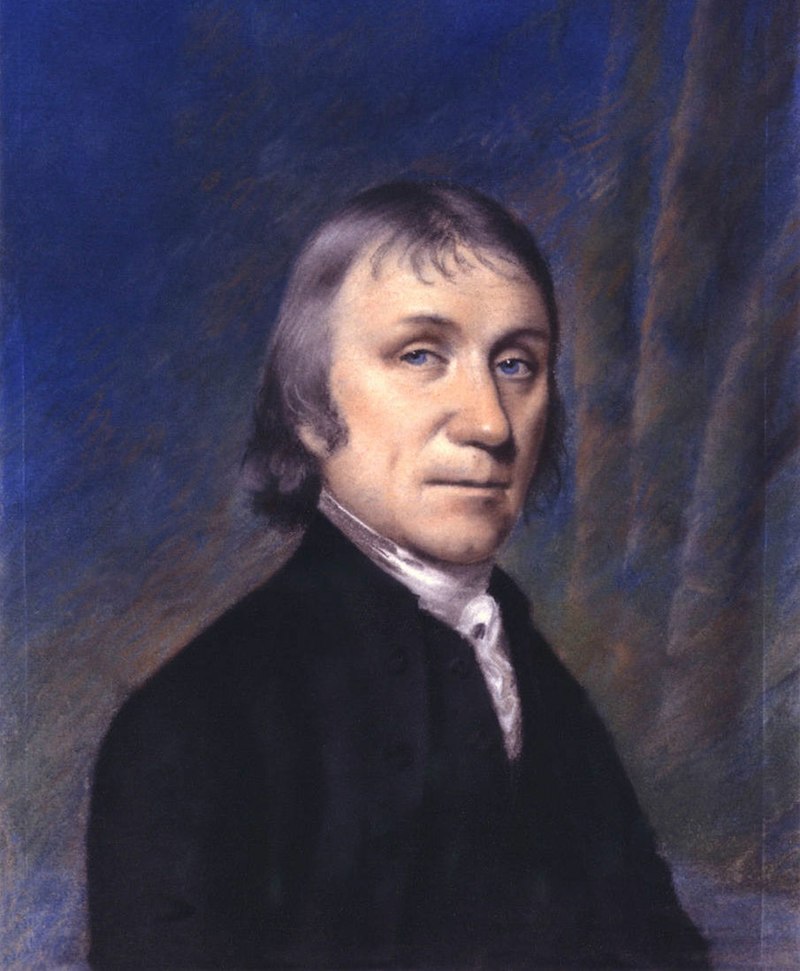
Joseph Priestley (1733 – 1804)


I am once again tackling a figure whose work lies on the borders of philosophy and science. I haven't read any one book from him, but instead, I have investigated a selection, the title of which (Priestley on science, philosophy and politics) reflects the variety of the thinker's interests. Because Priestley was also interested of religion, one might say that he played altogether four different roles.

Starting first from the role of a scientific investigator, we may note that Priestely is famous as one of the first people to separate oxygen from air. But Priestley's discovery is an important indication how different it is to do an experiment and to interpret it correctly, as he did not believe he had found a new element – instead, he thought he had managed to purify air from phlogiston, the element that supposedly caused all phenomena involving fire. Priestely quickly noted that this purified air was more invigorating than ordinary air and he also noted that plants appeared to emanate such air.

In addition to dabbling with scientific experiments, Priestly was also a historian of science and worked on an history of electrical studies. Still, perhaps most interesting work of Priestely on the topic of science are his plans for systematising scientific research. Priestly suggests that instead of founding huge societies responsible for all kinds of scientific study, there should be many small societies specialised for a small subfield in science and responsible for collecting funding for that field. In effect, Priestly is suggesting an idea common these days, that universities should concentrate their research on their strong areas.

Priestley's innovative skills were not restricted to mere research politics, but he was, secondly, an eager political thinker. His model of good society was clearly based on United States of America, as he was a stout defender of republicanism and demanded the right of citizens to have an extended field of action, in which state should have no say at all – Priestly goes even so far as to suggest that education should be no business of the state. Furthermore, Priestley speaks vehemently against any privileged class or nobility, except in case of such a class serving the needs of state. And while Priestley did condemn rebellions, he also noted that fight against tyranny was no true rebellion. In line with Priestley's rather Republican ideal of society is his insistence that criminals should be punished hardly, in order to deter anyone from committing a crime. Ironically, Priestly congratulates USA of not being a colonial power and of never falling into a civil war – a mere century would have proven him wrong.

An important part of Priestley's liberal ideal of state is a demand that all religious sects should be tolerated. This is an important element in his third role as religious thinker. Priestley was a unitarian, who thought that Christ did not have a divine nature. Indeed, his philosophical views went even farther away from the traditional religious views. For instance, Priestly denied the possibility of spontaneously working will, but insisted that all actions require some motive – even the act of going against a motive is never unmotivated. Somewhat surprisingly, in addition to basing this thesis on the universal validity of causal principle, Priestley also uses a religious argument – God could not foresee things ahead, if the events of the world would not work in a strictly deterministic manner. Furthermore, he also notes that morals would not work without complete determinism, since a randomly acting person could not be improved in any manner – she could always accidentally act in a completely different manner.


In addition to being a determinist, Priestly was also a materialist. Or, to put it better, he did not believe that there was any wide cleft between material and spiritual phenomena. Matter was not a plenuum or completely solid, but must have been full of emptyness, since it e.g. could be a medium for movement of light. And if matter was really not material in the brute sense of the word, Priestley argued, why could we not say that so-called soul is also made of matter?

keskiviikko 15. huhtikuuta 2015

Anne-Robert-Jacques Turgot: Reflections on the Formation and Distribution of Wealth (1774-1776)

1727-1781

If the history of economy should begin somewhere, it might began in 18th century, when thinkers like Adam Smith produced first analyses of the formation of prices of goods. Instead of Smith, I am studying a French economist, Turgot, and his main work, Réflexions sur la formation et la distribution des richesses.

Turgot's main point might be summarised as all wealth begins with land – a common assumption of the so-called physiocratic school of economy. The most concrete signal for this is that agriculture is almost a necessary requirement for human life. I am saying ”almost”, since human beings have lived before the invention of agriculture, through hunting and gathering. In Turgot's time the pre-historical human condition was, of course, not known, but even Turgot admits that cattle raising probably preceded the agricultural style of living.

Turgot begins from an idealised condition, in which everyone has enough land to satisfy his needs. He is quite aware that this is only a fiction, because difference e.g. in the types of land and in the needs of different persons would soon produce some noticeable differences. This fiction is just meant to emphasise how even in such equal circumstances difference of classes would soon arise.

Thus, Turgot notes that even in such a fictional state farmers would have difficulties in producing enough for their whole family. They would then need from time to time to hire people's help for some purposes – for instance, they might occasionally need someone to sew them new clothes that they wouldn't have time to do themselves. The outcome would be a division of populace to two classes: the producers tilling the land and the artisans or labourers.

Somewhat surprisingly, Turgot appears to say that the artisans do not truly produce any new wealth to the system. In a sense this is quite right, since artisans do not produce new raw materials, but in another sense it is also an exaggeration. Surely, say, finely crafted shoes are quite a different thing from materials it is made of (leather etc.), and indeed, more useful to many people than these materials, which is reflected in the price of the final product.

A further development of the economical system involves the differentiation in the amount of land producers own – some farmer might have more children to inherit him, so his land will be divided into smaller pieces, some people might use their economic or military power to gather up more lands etc. The final result of this development, according to Turgot, is that some people will have more farming land than they can themselves tend to, which means they must hire (as labourers) or force (as slaves) some people to till the land for him or rent the land forward and just take a share of the products of the land. In any case, this means that the class of land owners is distinguished from the producers, who are now in as bad condition as artisans, tilling the land just for their survival. Still, Turgot considers the producers more beneficial than artisans, since they bring about the real wealth.

A further development in the economy is provided by property that could be circulated, and hence, traded for other goods more freely than land – a farmer can barter barrels of wine for grains etc. Now, if every transaction would be completely independent of other transactions, there would be no general rule for e.g. how many barrels of wine one has to give for a certain portions of grain. Turgot insists that transactions are not independent – if one is unhappy with the prize, one can go and negotiate with another person. This possibility should create suitably fixed prizes in terms of trading one good for another. What Turgot doesn't consider is the possibility that the markets are not in general completely fair (e.g. one person might have access to a place, in which some commodity has a better prize than in another) and therefore one side of the transaction might be in disadvantage. Of course, this is all meant to be more of a description of how the market works than an ethical decision about its fairness.

The final change in the economy happens when some special type of commodity – usually a metal like gold or silver – has been chosen as a monetary unit, according to which all calculations can be measured. Turgot states that because money is changed into commodities, it must always be a commodity itself, thus, no mere artificial currency can exist. A somewhat closer to the truth, in light of later developments in economy, would be to say that every currency, and indeed any unit of trade, inevitably can become a commodity – something which can be bought and sold and which has its own fluctuating value that can be measured e.g. in comparison with other currencies.

The accumulation of wealth makes it then possible that some people live just by their money. In other words, a wealthy person with lot of money or other liquid assets can use his riches to finance enterprises that will bring him more profit. Using money to produce more money is according to Turgot far more profitable for the economy than wasting it to luxury, which by itself would just ruin the whole economy. Of course, this is a bit of an exaggeration, since luxuries would have to be bought somewhere, which would mean more circulation of wealth.

Behind Turgot's dismissal of luxury lies perhaps then a more ethical point – the circulation of wealth should be such that it produces most benefit to the whole society. Thus, Turgot notes that growth in the number of capitalists willing to finance leads to the prize of the loans (that is, the interest paid for loans) falling so that more people have a possibility to lend money. What Turgot seems to be missing is the possibility that this apparent growth of economic prosperity might lead to some people falling behind in the development and remaining in a state of relative or even absolute poverty.

Even more crucial is that while Turgot does talk of the importance of the land in forming wealth, he doesn't consider the idea that the resources of the land might be essentially limited, which would thus set finite bounds to the development of economy. Reading between the line, one can see in Turgot's claims a romantic vision of nature as an infinitely creative source of life and resources, which would sustain economic growth to all eternity, if just silly cultural restrictions would be lifted.


So much for Turgot, next time I shall take a look at certain English chemist.

keskiviikko 25. maaliskuuta 2015

Sir William Blackstone: Commentaries on the Laws of England (1766)

No wonder how silly it seems to us nowadays, it has been traditional in universities that students of law did not learn the laws of their own countries, but laws of ancient Rome. This was not just a perverted antiquarian interest, but Roman law was often felt to be an ideal to which modern systems of law should strive for – indeed, especially in the continent many courts did adopt some predicts from it. Furthermore, the Roman law was followed by one important institution in Europe, namely, the Catholic Church.

Sir William Blackstone's commentaries are meant to rectify the lack of knowledge for English students of law. At the same time, Blackstone attempts to show how reasonable the English laws are – for instance, he emphasises the respect of freedom in English law, which is so great that even a slave landing in English soil will automatically gain liberty.

I am obviously not going to go through the whole of this large treatise, and one might even wonder what such a book on law has to do with philosophy. It is now more of a case who was interested of the book – or more likely, who was interested enough to insult it. Bentham, a philosopher I will read some time in the future, was apparently quite critical of Blackstone's treatise – Bentham thought that no laws should be thought good just because they were handed down by the tradition.

In any case, Blackstone's book does have its more philosophical parts, especially in the introductory section, in which he explains what it means to be a law. Rather traditionally, Blackstone relates laws of nature as laws governing the movement of bodies with laws of human behaviour. Furthermore, he also follows tradition in speaking of a natural law, that is, law that naturally governs all human behaviour and decides what is morally right and wrong, permissible and not. Like in case of laws of nature, Blackstone thinks that the validity of the natural law is grounded on God's will. This might sound a bit old-fashioned these days, but the very idea of a culturally neutral basis on which to decide right and wrong – and especially on which to decide if laws of a nation are right and wrong – is one that seems still viable today.

When one accepts the existence of natural law, it becomes then quite natural to ask what makes it right that states make more laws to govern human behaviour. Following Locke, Blackstone follows a very common idea – that of a social contract – governments can pass laws, because the people have agreed to follow such laws or any laws government decree. Blackstone does not completely accept the theory, but admits the idea of an original contract to be nothing else than a convenient fiction – people implicitly accept the laws of the land they've chosen to live in. This sounds a bit spurious, since people sometimes have not accepted the laws of their home country, and indeed, often have no say on the matter where they live, political, cultural and even language barriers truncating the possibilities considerably.


I suspect this suffices for a quick look on Blackstone's book, since I am not about to go to technicalities of English law. Next time I shall look in more detail at some French notions of politics and economy.

torstai 19. maaliskuuta 2015

Jonathan Edwards: The End for Which God Created the World (1749), Nature of True Virtue (1749) and Original Sin (1758)

Jonathan Edwards 1703-1758

It appears that the first philosophers of the later United States of America were either politicians or clergymen. Jonathan Edwards (1703 – 1758) belongs especially to the latter group, and as is to be suspected, the topics of his works are rather biblical. Yet, they contain some obvious references to philosophical discussions of the time, and writers like Locke, Hutchinson and Hume are explicitly mentioned.

I shall begin somewhat nonsensically from the latest work, the posthumous book on original sin, mainly because the biblical/philosophical -ratio is heavily balanced on the biblical side. Edwards' target is apparently John Taylor, who wrote a rather non-traditional work on original sin, in summary proclaiming that it is actually not a biblical doctrine. I shall not go into great details to Edwards' argumentation that the doctrine does have a background in Bible. Far more interesting are the slight bits of philosophy hidden among all the biblical quotes and exegesis. For instance, Edwards considers the at first sight rather odd demand that Adam as the first human being could be seen as forming a one entity with all his progeny, thus making it reasonable to punish all mankind for Adam's sin. Edwards defends this view by simply noting that God as the creator of all laws, moral and natural, can decide that there is a lawful connection between the sin of Adam and the guilt of all humankind. Edwards thus jiggles towards God, when it comes to the famous Euthyphro dilemma: does God decide what is good or is good independent of God's decision?

Edwards also tries to answer the rather obvious criticism of original sin that an assumption of an inborn tendency to evil would undermine all morality, which can be applied only in cases where a free choice is made by the will – if a person already has a tendency to certain actions, he cannot be thought responsible of them, unless this tendency follows from an earlier sinful choice leading to that tendency. Edwards sees a problem in this argument. If one could not determine the guilt of someone not merely from his tendency to do evil actions, but only from a sinful choice, an infinite regress would ensue. The choice itself would be an action, the sinfulness of which could not be determined by a mere tendency to do such choices, if the chooser is to be responsible. Thus it would have to be caused by a further sinful choice and so on. In effect, Edwards is arguing that either all notion of responsibility must be null or then even a given tendency to do evil things can be judged evil. Edwards is obviously endorsing the second prong of the dilemma, but it might well be asked whether his arguments could be used for denying validity of all moral evaluations.

The short writing on the end of the world has also a religious theme and Biblical exegesis is also used as an argument, but the work contains also interesting arguments. The main result of the work feels rather Neo-Platonist: God must, as it were, emanate and let his perfection become an active force, or otherwise it wouldn't be so perfect. In other words, God is like an artist that must unleash his creativity and create a world that perfectly reflects himself. One might of course ask why God has not created world for the living beings and their happiness and think of God as self-centered, because of his motives, but Edwards notes that the two ends need not necessarily contradict one another. To this end, Edwards introduces an important distinction between ultimate and final end. Final end is just an end that is not means and there could well be many final ends. Still, some of these final ends are more important than others and most important of these is what Edwards calls the ultimate end.

Edwards also explains the distinction between final and ultimate ends through the following analogy. Picture a man who tries to get married, not for the sake of anything else, but for the sake of marriage itself. The marriage is thus a final end of the man. Now, after the marriage is in force, the man might have another final end, like living a peaceful life of a husband. Still, the original ending was more ultimate, because the man couldn't have even hoped for the new final end without first reaching the first end. Similarly, one might imagine that God had at first just the final end of creating the world as a representation of his own glory, but later on God decided to also care for the denizens of the world. Note the interesting hint that Edwards might apply temporal terms to God's existence, which appear to imply that even God could change his mind.

The work on the nature of true virtue seems by far the least finished, but it is most clearly a philosophical work, but I will only have space to note some interesting points. The true virtue for Edwards is the love of God as the true source of all being. In other words, in loving God, a person loves also everything else, as reflecting God, while mere love towards anything else – even the whole universe – will contain only a limited fraction of all the possible love and will thus be deficient and even evil in comparison with the ultimate love. Out of this rather religious and mystical basis Edwards manages to make rather intriguing comments on ethics in general.

For instance, Edwards raises the question whether self-love can be a basis of virtue. He notes that the question is actually ambiguous, because self-love can be understood in two different manners. Firstly, self-love might just refer to a want of feeling good. In that sense, Edwards states, self-love can truly be basis of virtue, because, contrary to Kant would later say, even a virtuous person can and even should feel good about what he does – by loving and helping others, one also loves and helps oneself.

Secondly, self-love might also mean caring for one's own advantage. Such a selfish desire will inevitably restrict one's love in some manner and will thus close of a person from true virtue, Edwards concludes. Then again, he admits that such selfishness need not be completely closed off from love of other people. A selfish person might well note that e.g. taking care of some limited group of persons (say, one's family or country) one does good to oneself also. Thus, self-love in the second sense can at least be basis of limited love of others.

Edwards also discusses the idea of Hume and Hutschinson that morality is ultimately not based on reasoning, but on some feelings, like sympathy. Edwards agrees with the sentiment partially. He admits that morality is quite likely to be genetically based on feelings. Indeed, he suggests that God himself must have instilled such instinctual feelings to human mind, in order to guide them towards good life. Then again, Edwards does not accept the idea that feeling would be the ultimate foundation of all morality – even if we would become aware of morality through feelings, this does not mean that we could not argue for morality through proper reason. Edwards especially wants to steer away from the idea that a beginning of morality in feelings would make morality somehow relativist. Instead, Edwards emphasises that certain basic moral sentiments are spread universally throughout human race and are therefore most likely absolute decrees of God.

The works of Edwards show thus an interesting interaction between religion and philosophy that has been quite apparent in the few American philosophers I have now read. Next time I shall move back to the Old World and to laws of England.