Näytetään tekstit, joissa on tunniste philosophy in America. Näytä kaikki tekstit

sunnuntai 2. huhtikuuta 2023

Amos Bronson Alcott (1830): Observations on the Principles and Methods of Infant Instruction


(1799-1888)

Amos Bronson Alcott is undoubtedly less known than his daughter, Louisa May Alcott, the author of Little Women. Even in the field of philosophy, he is overshadowed by the fame of his associates, Emerson and Thoreau, who, together with Alcott, were part of the so-called Transcendentalist movement.


What we are looking at in this article is Alcott’s work as a reformer of education. Alcott himself worked as a school teacher, but we are especially interested in his theoretical work on the topic of education, and particularly on infant instruction, where the infants in question are meant to be under the age of primary school, from two to seven years. Alcott’s main principle is the time-honoured idea, familiar from Plato onwards, that education means not just external pouring of information in a person's mind, but development of propensities already nascent within the mind.


Underlying Alcott’s ideal of education is also a notion of what it means to be a human. Humans are for Alcott active beings with a twofold nature, animal and intellectual. While the aim of education is especially the development of the intellectual side of the human being, the animal side should not be ignored. This is especially true of small children, where animal nature is still stronger than intellectual nature. Like the whole human being, their animal nature is also active. Thus, Alcott concludes, the natural physical energy of children should not be bound down, but allowed to develop through playing. By letting children use their physical energy, the teacher pacifies their animal nature and creates room also for the development of the intellect.


Children seek primarily enjoyment, Alcott says. He thinks this is a perfectly natural desire, but the task of education is just to direct this desire to lasting sources of enjoyment. Still, because small children prefer very immediate forms of enjoyment, their instruction must  remain at a very concrete level and leave abstract reasoning for the higher levels of education. Route memorising is to be replaced by amusing stories, pictures, music and poetry.


Alcott also endorses the idea that human beings feel a natural sympathy toward one another and are thus by nature communal animals. This implies, Alcott suggests, that the teacher should encourage the use of this natural sympathy and especially use it to build up the conscience of the children. The best way to do this, Alcott think, is that the teachers themselves become an object of children’s affection and thus serve as their role models, showing toward them the same kindness they want to awaken in them. If this succeeds, he concludes, the children become, in a proper Kantian fashion like law to themselves.

keskiviikko 27. heinäkuuta 2016

Thomas Paine: The Age of Reason (1794, 1795 and 1807)

Thomas Paine (1736-1809)

We return from France to America, to yet another of the Founding Fathers of the United States, only to quickly return to France. Thomas Paine had a hand in two revolutions, being also a member of the revolutionary Convent. As a foreigner and a known ally of a moderate republican Girondin movement, he was imprisoned, when the radicals led by Robespierre had managed to take control of the government. While in prison, Paine wrote the first part of his The Age of Reason, a book investigating Christian religion from the standpoint of Deism.

After being salvaged from impending death by the execution of Robespierre, Paine added two further parts to the book. In the prison cell, he had had no Bible to check, and the final parts are meant to accommodate for that fault: Paine goes painstakingly through various books of the Bible, finding out evidence suggesting that the book is not a work of divine revelation.

Paine's primary strategy is to point out internal incoherencies – Moses couldn't have written the first books of the Bible, because he dies before the end of the book, supposed prophecies pointing to the coming of Christ were actually related to ancient affairs of Jews and their kingdoms etc. Although this part of Paine's book was quite relevant when it appeared, it seems trite nowadays, since no one in his right mind takes Bible as a literal source of history. Of course Bible has it inconsistencies – just the existence of two different creation stories belies this. But far more interesting than such biblical nitpicking is to ask why these stories, with all their inconsistencies, have been able to cause a feeling of divinity in their readers.

A more interesting avenue of criticism lies in Paine's discussion of dreams – or the criticism itself is again quite trite (dreams of a person are no proper testimony, and even if God would have used them to reveal his will to people, this power of revelation would only hold for those who had the vision), but the machinery behind this criticism is interesting. Paine sets out an intricate picture of human mind. The driving force of mind is imagination, Paine says, and its activities are recorded by memory and regulated by judgement. Imagination works always, but memory and judgement often rest during sleep. When memory is not working, we don't have any recollection of what we have thought. When memory is working, but judgement is not, we are dreaming.

In addition to incoherence, Paine criticized the supposed immorality of Bible. Lot of this criticism is undoubtedly to the point – stories of ancient Israelites killing innocent babies are cruel. Still, Paine's disdain is also at times difficult to understand. Thus, Paine thinks that the idea of God forgiving sins would be detrimental to morality, because bad deeds would not then be punished in any way. Yet, one might say that at least in some cases true repentance is an acceptable option for external punishment.

Another part of Paine's crusade against the impious Bible is his insistence that the biblical notion of immortality is crass. Christianity speaks of bodily resurrection, but, Paine suggests, a body similar to our current body would just wind out just as our current bodies. Thus, he concludes, immortality must mean change into a completely different, more perfect plane of living. Paradoxically, Christian notion of immortality is then denied by Paine because it is too materialistic – a reason why it was easy for Christian philosophers to accept Aristotelian notion of soul.

After having thrown away all of Bible, Paine directs his reader to the true revelation of God, that is, nature. There is not much original in Paine's naturalistic theology, but we might notice one curious detail in it, namely, Paine's attitude towards mathematics. It appears that Paine thinks even mathematical truths were designed and chosen by God. Thus, mathematics becomes one of the natural sciences, because e.g. the relationships of different triangles are in Paine's eyes evidence for God's existence.

maanantai 4. tammikuuta 2016

Thomas Jefferson (1743-1826)


It is a question raised in recent years, whether liberalism, that supposed liberator of humankind, has actually been tainted with a foul crime to humanity – I am speaking, of course, about the slavery. Many leading liberalist thinkers, like John Locke, wrote in favour of enslavement of black Africans, and especially on the western side of Atlantic, they even owned slaves. This involves a complex line of ideas that I cannot follow here, but the basic question appears to be whether the liberation of one class of humans from traditional restrictions of religious morality and the establishment of first capitalist systems might somehow have worsened the state of the people used by this enlightened persons as their household equipment.

Thomas Jefferson apparently is one of the most contradictory persons in this context: one of the largest slave holder in the country, yet, denied the right to import slaves to United States, yet, did nothing to discourage the local slave trades, yet, did plan on gradual liberation of slaves, yet, held Africans to be inferior to Europeans – a list of paradoxes that just keeps growing. This is an interesting muddle to deal with, but one which I regretfully will have to leave for specialists of Jefferson's thought.

I am now mostly interested in Jefferson's religious ideas, or more precisely, in the way how he suggested religion should be seen in the affairs of state. Of course, his religious ideas as such are also of interest. Apparently, he had constructed his very own version of Gospels, cutting up pieces of life story and sayings of Jesus from all the Gospels and putting it all together into a whole. Particularly, Jefferson had discarded all descriptions of miracles and all suggestions of the divinity of Jesus, which might suggest that he was a deist of some sort.

Although Jefferson thus disparaged all ideas of supernatural, he appears to still have been interested of Christianity – why else would he go through the trouble of picking up lines from Bible? The idea of Jesus as a mere teacher of morality was, of course, a standard line in Enlightenment. Yet, it is of interest what Jefferson appropriated from these moral teachings.

The famous Virginia Statue of Religious Freedom (1777) begins with a statement that God created human beings free (well, technically Jefferson is speaking only of ”man”, but I am giving him the benefit of doubt and assume he isn't really restricting his statement to one gender). This is a crucial assumption in many versions of Christianity – freedom is an essential precondition for human responsibility (of course, Augustine might be of a different opinion, but I doubt Jefferson really cared about Augustine in this matter).

When Jefferson speaks of God as an author of ”our religion”, that is, Christianity, it is difficult to say how serious he really is – even if Jefferson believed in God, his God probably was an author of no religion. Yet, this statement is obviously a rhetorical move – it gives an air of authority and responsibility for what Jefferson is about to say.

Jefferson's strategy is to take some of the central ingredients of Christianity (or what he sees as these central thoughts). Humans are created free, thus, we must respect their freedom in every matter. Especially this holds of religion. If God would have wanted, he could have made us follow Christiniaty by default – yet, we know by experience he hasn't. Thus, we must follow God's example in this case and let everyone decide their own religious opinions for themselves, especially as every human being is by default prone to fall in error and thus no one person's judgement on religious affairs should be followed.

Jefferson's idea concurs with modern sensibilities, and his argument is also quite beautiful, relying on central ideas of the supposed opposition. It is quite astonishing to think that two quite different influences were behind the American revolution – the freethinking deism of Jefferson and the belief in personal guidance of God by Benjamin Franklin. A more speculative thinker might even suggest that these two ideologies are still battling of the spirit of American people, perhaps in the guise of very party system of that country.

torstai 19. maaliskuuta 2015

Jonathan Edwards: The End for Which God Created the World (1749), Nature of True Virtue (1749) and Original Sin (1758)

Jonathan Edwards 1703-1758

It appears that the first philosophers of the later United States of America were either politicians or clergymen. Jonathan Edwards (1703 – 1758) belongs especially to the latter group, and as is to be suspected, the topics of his works are rather biblical. Yet, they contain some obvious references to philosophical discussions of the time, and writers like Locke, Hutchinson and Hume are explicitly mentioned.

I shall begin somewhat nonsensically from the latest work, the posthumous book on original sin, mainly because the biblical/philosophical -ratio is heavily balanced on the biblical side. Edwards' target is apparently John Taylor, who wrote a rather non-traditional work on original sin, in summary proclaiming that it is actually not a biblical doctrine. I shall not go into great details to Edwards' argumentation that the doctrine does have a background in Bible. Far more interesting are the slight bits of philosophy hidden among all the biblical quotes and exegesis. For instance, Edwards considers the at first sight rather odd demand that Adam as the first human being could be seen as forming a one entity with all his progeny, thus making it reasonable to punish all mankind for Adam's sin. Edwards defends this view by simply noting that God as the creator of all laws, moral and natural, can decide that there is a lawful connection between the sin of Adam and the guilt of all humankind. Edwards thus jiggles towards God, when it comes to the famous Euthyphro dilemma: does God decide what is good or is good independent of God's decision?

Edwards also tries to answer the rather obvious criticism of original sin that an assumption of an inborn tendency to evil would undermine all morality, which can be applied only in cases where a free choice is made by the will – if a person already has a tendency to certain actions, he cannot be thought responsible of them, unless this tendency follows from an earlier sinful choice leading to that tendency. Edwards sees a problem in this argument. If one could not determine the guilt of someone not merely from his tendency to do evil actions, but only from a sinful choice, an infinite regress would ensue. The choice itself would be an action, the sinfulness of which could not be determined by a mere tendency to do such choices, if the chooser is to be responsible. Thus it would have to be caused by a further sinful choice and so on. In effect, Edwards is arguing that either all notion of responsibility must be null or then even a given tendency to do evil things can be judged evil. Edwards is obviously endorsing the second prong of the dilemma, but it might well be asked whether his arguments could be used for denying validity of all moral evaluations.

The short writing on the end of the world has also a religious theme and Biblical exegesis is also used as an argument, but the work contains also interesting arguments. The main result of the work feels rather Neo-Platonist: God must, as it were, emanate and let his perfection become an active force, or otherwise it wouldn't be so perfect. In other words, God is like an artist that must unleash his creativity and create a world that perfectly reflects himself. One might of course ask why God has not created world for the living beings and their happiness and think of God as self-centered, because of his motives, but Edwards notes that the two ends need not necessarily contradict one another. To this end, Edwards introduces an important distinction between ultimate and final end. Final end is just an end that is not means and there could well be many final ends. Still, some of these final ends are more important than others and most important of these is what Edwards calls the ultimate end.

Edwards also explains the distinction between final and ultimate ends through the following analogy. Picture a man who tries to get married, not for the sake of anything else, but for the sake of marriage itself. The marriage is thus a final end of the man. Now, after the marriage is in force, the man might have another final end, like living a peaceful life of a husband. Still, the original ending was more ultimate, because the man couldn't have even hoped for the new final end without first reaching the first end. Similarly, one might imagine that God had at first just the final end of creating the world as a representation of his own glory, but later on God decided to also care for the denizens of the world. Note the interesting hint that Edwards might apply temporal terms to God's existence, which appear to imply that even God could change his mind.

The work on the nature of true virtue seems by far the least finished, but it is most clearly a philosophical work, but I will only have space to note some interesting points. The true virtue for Edwards is the love of God as the true source of all being. In other words, in loving God, a person loves also everything else, as reflecting God, while mere love towards anything else – even the whole universe – will contain only a limited fraction of all the possible love and will thus be deficient and even evil in comparison with the ultimate love. Out of this rather religious and mystical basis Edwards manages to make rather intriguing comments on ethics in general.

For instance, Edwards raises the question whether self-love can be a basis of virtue. He notes that the question is actually ambiguous, because self-love can be understood in two different manners. Firstly, self-love might just refer to a want of feeling good. In that sense, Edwards states, self-love can truly be basis of virtue, because, contrary to Kant would later say, even a virtuous person can and even should feel good about what he does – by loving and helping others, one also loves and helps oneself.

Secondly, self-love might also mean caring for one's own advantage. Such a selfish desire will inevitably restrict one's love in some manner and will thus close of a person from true virtue, Edwards concludes. Then again, he admits that such selfishness need not be completely closed off from love of other people. A selfish person might well note that e.g. taking care of some limited group of persons (say, one's family or country) one does good to oneself also. Thus, self-love in the second sense can at least be basis of limited love of others.

Edwards also discusses the idea of Hume and Hutschinson that morality is ultimately not based on reasoning, but on some feelings, like sympathy. Edwards agrees with the sentiment partially. He admits that morality is quite likely to be genetically based on feelings. Indeed, he suggests that God himself must have instilled such instinctual feelings to human mind, in order to guide them towards good life. Then again, Edwards does not accept the idea that feeling would be the ultimate foundation of all morality – even if we would become aware of morality through feelings, this does not mean that we could not argue for morality through proper reason. Edwards especially wants to steer away from the idea that a beginning of morality in feelings would make morality somehow relativist. Instead, Edwards emphasises that certain basic moral sentiments are spread universally throughout human race and are therefore most likely absolute decrees of God.

The works of Edwards show thus an interesting interaction between religion and philosophy that has been quite apparent in the few American philosophers I have now read. Next time I shall move back to the Old World and to laws of England.

torstai 8. tammikuuta 2015

Samuel Johnson: Elementa philosophica: containing chiefly, Noetica, or things relating to the mind or understanding: and Ethica, or things relating to the moral behavior (1752)

Samuel Johnson (1696 -1772)

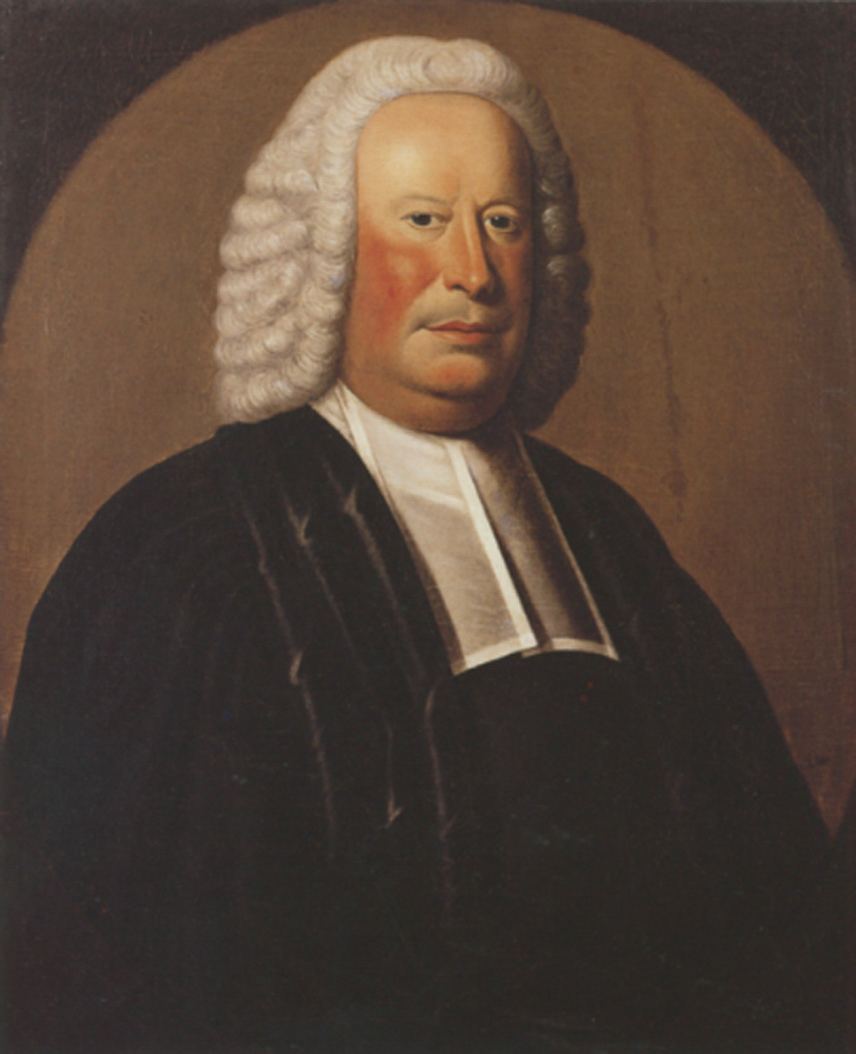
Returning from the Old to the New World we meet the reverend Samuel Johnson and his Noetics and Ethics. The title page of the work reveals a connection to an earlier figure I've spoken about: the book was printed by none other than Benjamin Franklin.

What is more interesting is Johnson's connection with bishop Berkeley. It should be best to point out first that Samuel Johnson I am speaking of is not the Samuel Johnson who wrote the first dictionary of English and famously argued against Berkeley by kicking a stone – that man lived in London. This Johnson was in fact quite appreciative of Berkeley's philosophy and had even met the reverend, when Berkeley was visiting Rhode Island.

While Berkeley's most famous philosophical works are quite focused on few central topics – e.g. that existence can be defined through capacities of being perceived and perceiving, that matter as neither perceptible nor perceiving does not exist and God causing our perceptions directly – in Johnson's book these topics are barely mentioned. The first part, Noetics, focuses on questions that in continental Europe were addressed in books on logic: how does human mind work and how it is to be properly educated and used. Berkeley's theses work as a sort of ontological underpinning of this methodological framework – a novel attempt, at least.

Johnson's take on Berkeley's philosophy seems rather peculiar. He appears to think that the essential message of esse est percipi is that everything we see is as it is – there is no reality behind perceptions, which can then be directly identified with things themselves. So, we do know that there are horses, because we definitely see them running about. This is, of course, what Berkeley himself professed – he thought he was upholding the common sense against sceptical attacks inherent in Locke's philosophy.

More peculiar is that Johnson at once assumes many ontological notions Berkeley had suggested were quite unnecessary and meant really nothing. Thus, while Berkeley thought there was no reason to speak of any substance or substrate behind perceived properties, Johnson notes there is a perfectly valid sense of substance – certain combinations of simple perceptions just are substances. Furthermore, Johnson also find a use for the concept of matter, which Berkeley had discarded as leading to skepticism – material things just are those that are defined by being perceived. All of this is a symptom of Johnson taking universalisation and abstraction far more seriously – an understandable view in a study leading all the way to scientific generalities.

After the Berkeleyan underpinnings Johnson's Noetics seems a rather traditional work – once he gets to the level of concepts, he can just follow in the footsteps of traditional syllogistics. He also presents a rather traditional metaphysical account of world – being perceived (being acted upon) and perceiving (acting) define two kinds of beings, material things and spirits. Clearly spirits as the more active component are somehow more robust and more essential. Behind all the material things and spirits lies the perfect spirit or God.

Johnson's Ethics feels even more traditional. The aim of the second part is to secure human happiness, which is one purpose of God and which results not through excessive pleasure, but through moderation. Indeed, Johnson can point out to a result from Noetics that spirits are somehow more important than material things, which are nothing more than mere perceptions – one cannot find true happiness with mere passive perceptions, but it must be found in spiritual matters.

So much for Samuel Johnson, I'll now return to Condillac.

torstai 31. heinäkuuta 2014

Benjamin Franklin: Two Dialogues between Philocles and Horatio, concerning Virtue and Pleasure (1730)

A student of philosophy might think that American philosophy sprang straightaway from the heads of Charles Peirce and William James or even that before Quine nothing of note happened at the other side of Atlantic. Undoubtedly philosophy in America cannot have as long roots as philosophy in Europe, but it still wasn't as recent innovation as it might seem. Indeed, the Founding Fathers of United States have often been described as philosophers. Admittedly, they are far from systematic and scholarly philosophers, and many of them might be better characterised as men of letters, concerned with things like the relation of an individual and a society and the role of religion in modern state. Furthermore, instead of a theoretical framework, their main achievement is of a more practical nature, that is, the constitution of the independent United States of America.

Historically important, but where they philosophers?

One of the Founding Fathers, Benjamin Franklin, is especially famous for having founded the American Philosophical Society. Yet, the name is somewhat misleading, since by philosophy often all kinds of learning were meant in those days. Thus, American Philosophical Society might well be considered a republican version of the British Royal Society. In this sort of philosophy Franklin was, of course, famous, as is proven by the description of him often found in history text books – holding a kite and waiting lightning to strike it.

At least the tale's good for dramatic portraits

Franklin's collected works take up ten volumes, getting to know which I am not going to spend all my time, especially as Franklin seems to have no clear major work engaged with philosophical issues. Instead, I chose a short dialogue explicitly concerned with such philosophical issue as good life. The dialogue was published, when Franklin was quite young, so it should definitely not be seen as his final statement on the topic.

The participants of the dialogue are called Philocles and Horatio – I am not sure if Franklin chose intentionally a Greek and a Roman character or whether he just couldn't tell the ethnicity of the names. Whatever the case, Horatio is clearly presented as a traditionally Epicurean character, caring only about pleasures, while Philocles opts for a loftier standpoint.

It comes as no surprise that Franklin sides with Philocles. Yet, his strategy is not to disparage pleasures altogether, but only to argue for a hierarchy in pleasures: some pleasures are inherently better than others (John Stuart Mill would later become famous for saying something like that). Horatio of the dialogue, on the other hand, assumes that there is no objective criterion for the worth of pleasures and that everyone must decide for themselves what pleasures are worth pursuing.

Franklin lets Philocles attack Horatio by stating that certain pleasures will lead to unwanted consequences: a man spending all his money and health on intense sensual pleasures will become economically and physically broke in very young age and have no viable alternative, but commit a suicide. This unwanted end can be prevented, Philocles continues, only through self-denial, that is, by avoiding such intense pleasures. Further in the dialogue, in its second part, Philocles then sets out his own alternative: while sensuous pleasures are always fleeting, altruistic pleasures arising out of helping other people are lasting and should thus be pursued.

One can at first point out that Franklin's dialogue is far from a theoretical work on metaethics, but instead is very down-to-earth, discussing practical mores and not high-blown principles. Even more, the outlook of Franklin is utilitarian: what makes altruism viable is the pleasure it produces. While I find sympathetic a position that defends altruism for increasing pleasure (altruist is happy not just of his own good luck, but also of the good luck of others), Franklin's argumentation has still some glaring holes. He concentrates on good works improving the condition of others. But what if everyone already lives in a content state, how then to improve their condition? Furthermore, it seems obvious that such an altruistic enjoyment is dependent on the enjoyment of another human being and that ultimately this series of enjoyment must end in some independent enjoyment, which does not depend on enjoyment of another human being – that is, non-altruistic enjoyment. In other words, while altruism can multiply pleasure, it cannot be its only source.

Even more suspect is the argumentation in the first part of dialogue. Franklin want us to conclude that a short life full of intense pleasures is inherently worse than a long life with less intense pleasures. Yet, if the only criterion of the worth of a life is its pleasantness, it could well be that a sum of intense pleasures during a short life would exceed a sum of less intense pleasures during a long life – just like a rectangle with a short base and a long height could have greater area than a rectangle with a longer base, but shorter height.

Furthermore, Franklin's suggestion that it is always better to deny some pleasure, if it leads to better life in the future, is somewhat misleading. Consider a person who always leaves half of his year's earnings unused, in order to have a decent fortune that would sustain him in his old years. If this person dies now in his sixtieth year, without ever having used the fortune he had collected, the fortune never really served him, and on the contrary, he had to life a paltry life because of his savings.


This is all I'll say about the dialogue. Next time I shall turn my eyes from the Founding Fathers of USA towards thinkers of French Enlightenment.