Although one would have assumed that celestial geometry concerns only such properties as the distance, figure and size of celestial objects, Comte defines these as only one class of phenomena in stellar geometry, namely, static phenomena. He spends considerable time explaining how astronomers can determine these static phenomena, that is, measure our distance from various stellar objects, recognise the figure of these objects, investigate their size and even note the density of their atmosphere. Comte also describes the history of attempts to determine the shape of the Earth, noting that even if there has always been room for making details more precise, this does not mean that the advance of science has been just replacing one error with another.
Comte is clearly more interested in the dynamic phenomena involving movement of celestial objects. He recounts in great detail the history of the discovery of Earth’s movement, both around its axis and around the Sun. What Comte finds philosophically interesting in this discovery is that it has forced us to abandon the theological idea of humans as the centre of the whole universe and also the teleological idea of planets moving for some purpose. This does not mean that astronomy has made the world meaningless, he soothes the reader, since through it we have found the lofty idea of humans as intelligences discovering the laws of the universe even from an insignificant vantage point.
A second important consequence of these discoveries is, Comte says, that we must distinguish the notions of world and universe. By world he means our region of universe, consisting of Earth and its nearby celestial objects – effectively, the Solar System. While people of earlier times could have thought that there is nothing beyond this world, modern astronomy must assume that the universe continues beyond our world, even if we cannot say anything certain about what happens beyond the confines of our world.
It is just to be expected that Comte still has much to say about the three laws of Kepler. He is especially keen to point out that Kepler had to overcome former mythological ideas, involving the notion of a circle as the perfect and thus the only suitable orbit for the supposedly divine stars. The great effect of these laws, Comte suggests, is that they allow us to make predictions about the orbits of planets, satellites and comets. Yet, he adds, even these laws are mere approximations of celestial mechanics – the topic of my next post.
Näytetään tekstit, joissa on tunniste philosophy of science. Näytä kaikki tekstit
Näytetään tekstit, joissa on tunniste philosophy of science. Näytä kaikki tekstit
maanantai 26. toukokuuta 2025

sunnuntai 18. toukokuuta 2025
Auguste Comte: Course of positive philosophy 2 (1835)
The second volume of Comte’s Cours de philosophie positive starts with the topic of astronomy. The position of this science is not arbitrary, since he thinks it to be the highest of all natural sciences. True, it is preceded by mathematics, because astronomy depends on geometry and mechanics, but these are more like methodology in comparison, while astronomy is the first science dealing with concrete objects.
Comte sees the importance of astronomy in its being the most perfect science. True, he admits, astronomy has its practical uses, for instance, in determining longitudes, but its premier importance lies in its purity from all theological and metaphysical considerations. Indeed, Comte suggests, astronomy frees us from all teleological considerations, since it shows that Earth is just one among planets and not the centre of the universe, with humans as the end of everything,
As a science, Comte says, it is not just a collection of facts about positions of stars, but its task is to determine laws, through which to predict these positions. Indeed, he adds, astronomy has been the only science that has reduced all the phenomena it describes into one law: gravity. It is thus, in a sense, the least complex of all concrete sciences.
The simplicity of astronomy, Comte suggests, is seen also in the fact that it has the least amount of methods it can use. We cannot do any astronomical experiments nor can we really compare our observations to analogical cases in other circumstances (no space travel yet in Comte’s time). The only methods available are then direct observation of celestial phenomena and mathematical calculations. Indeed, Comte adds, astronomy even uses proportionally more calculations than observations, being the most mathematical of concrete sciences.
Comte insists that astronomy is independent of all other concrete sciences. He does admit that an astronomer must know something about physics and even chemistry for the sake of perfecting their instruments and for making necessary corrections for such matters like refraction of the light of celestial objects. Yet, Comte insists, astronomy is independent in the sense that we have and even cannot have any idea of the chemical or mineralogical constitution of the stars and planets or even of their temperature (all of this, of course, has been proven wrong, since we nowadays do speak about these matters).
On the other hand, Comte suggests, facts of all the other concrete sciences depend on facts of astronomy. Even sociology depends on astronomy, he insists, because even a slight variation on the orbit of Earth would change our societies enormously (considering that Comte insists that all concrete sciences should have some empirical basis, he does jump to this conclusion rather quickly).
Since all physical and chemical considerations are removed from astronomy, we are left with merely geometrical and mechanical properties of celestial bodies. Thus, Comte quite naturally divides astronomy into celestial geometry, studying forms and sizes of celestial objects, and celestial mechanics, studying their motions and forces.
In addition to these two disciplines, Comte suggests that we can also divide astronomy into solar astronomy, studying only our solar system, and sidereal astronomy, studying all celestial objects. He also adds that we should restrict our attention to solar astronomy, since other solar systems do not really affect us.
Comte sees the importance of astronomy in its being the most perfect science. True, he admits, astronomy has its practical uses, for instance, in determining longitudes, but its premier importance lies in its purity from all theological and metaphysical considerations. Indeed, Comte suggests, astronomy frees us from all teleological considerations, since it shows that Earth is just one among planets and not the centre of the universe, with humans as the end of everything,
As a science, Comte says, it is not just a collection of facts about positions of stars, but its task is to determine laws, through which to predict these positions. Indeed, he adds, astronomy has been the only science that has reduced all the phenomena it describes into one law: gravity. It is thus, in a sense, the least complex of all concrete sciences.
The simplicity of astronomy, Comte suggests, is seen also in the fact that it has the least amount of methods it can use. We cannot do any astronomical experiments nor can we really compare our observations to analogical cases in other circumstances (no space travel yet in Comte’s time). The only methods available are then direct observation of celestial phenomena and mathematical calculations. Indeed, Comte adds, astronomy even uses proportionally more calculations than observations, being the most mathematical of concrete sciences.
Comte insists that astronomy is independent of all other concrete sciences. He does admit that an astronomer must know something about physics and even chemistry for the sake of perfecting their instruments and for making necessary corrections for such matters like refraction of the light of celestial objects. Yet, Comte insists, astronomy is independent in the sense that we have and even cannot have any idea of the chemical or mineralogical constitution of the stars and planets or even of their temperature (all of this, of course, has been proven wrong, since we nowadays do speak about these matters).
On the other hand, Comte suggests, facts of all the other concrete sciences depend on facts of astronomy. Even sociology depends on astronomy, he insists, because even a slight variation on the orbit of Earth would change our societies enormously (considering that Comte insists that all concrete sciences should have some empirical basis, he does jump to this conclusion rather quickly).
Since all physical and chemical considerations are removed from astronomy, we are left with merely geometrical and mechanical properties of celestial bodies. Thus, Comte quite naturally divides astronomy into celestial geometry, studying forms and sizes of celestial objects, and celestial mechanics, studying their motions and forces.
In addition to these two disciplines, Comte suggests that we can also divide astronomy into solar astronomy, studying only our solar system, and sidereal astronomy, studying all celestial objects. He also adds that we should restrict our attention to solar astronomy, since other solar systems do not really affect us.
keskiviikko 22. joulukuuta 2021
Auguste Comte: Course of positive philosophy 1 - Solving equations
In a way that sounds rather old-fashioned these days, Comte defines mathematics as a science of measuring magnitudes. Of course, back in his days, mathematics was mostly about numbers, so the definition makes more sense. Furthermore, Comte instantly qualifies his statement, by noting that immediate measuring of, say, length with a ruler or temperature with thermometer is not yet mathematics. Instead, mathematics is all about indirect methods of measuring unknown magnitudes through their relations to others, known magnitudes. In other words, mathematics has to do with solving equations between magnitudes.
Comte is convinced that mathematics is a universal science that applies in principle to anything. His conviction means that everything should be in principle quantifiable. Comte mentions that this is in direct opposition to Kant’s table of categories, where qualities are kept strictly separate from quantities (this seems a rather peculiar way to understand Kant’s division of categories, but I’ll let it pass now). Even organic and social phenomena should be quantifiable, although their complexity might prevent us ever giving a full quantification of them, Comte hastens to add.
Comte divides mathematics into two parts. One part or concrete mathematics deals with measuring magnitudes in empirical and phenomenal matters, such as geometry and mechanics - I shall leave these disciplines to a later post. The other part deals with measuring magnitudes in abstract fashion, or as Comte puts it, with the logic of mathematics. More precisely, the topic of abstract mathematics consists of, Comte says, equations between abstract functions. By function Comte means some type of dependency, for instance, a sum of two magnitudes is their function, because the sum is dependent on what the magnitudes are. Now, abstract function is a dependency that can be understood only on the basis of bare magnitudes or numbers - sum of two magnitudes is the same, no matter whether the magnitudes are units of length, time, mass etc. On the contrary, concrete function expresses a dependency, understanding of which requires something more than mere numbers, such as geometric or mechanical properties.
Comte’s definition might still leave it unclear what to actually include in the abstract functions. He points out that we can at least enumerate some examples of pairs of simple abstract functions (pairs, because they consist of a function and its inverse). He adds that we can then know that any complex function that could be constructed from these simple functions is also an abstract function. These pairs would at least include, Comte recounts, addition and its inverse or subtraction, multiplication and division, raising to a power and roots, and exponential and logarithmic functions.
A more intricate question is whether to include among abstract simple functions also sinus and inverse sinus. The question is difficult, because if sinus is taken as a simple, unanalysable function, then it seems far from numerical, since it receives its meaning from a certain geometrical context (e.g. a unit circle). Then again, sinus can be defined in a purely numerical fashion, but then it is not anymore a simple function. Yet, just because of this dual nature Comte accepts the pair among simple functions, and instantly notes that other functions might also deserve to be included for the same reason, for instance, Jacobi’s theta-function.
Comte divides abstract mathematics into two disciplines, corresponding to two stages of solving equations. Firstly, one transforms or resolves functions given in the equation into other, more easily solvable forms - this is the task of algebra. Secondly, one finds the values of these easier functions - this is the task of arithmetic. Comte notes that this notion of arithmetic is more extensive than what is usually meant by it, since it includes also e.g. the use of logarithmic tables. He also points out that arithmetic is in a sense just a special case of algebra, since finding a value for a certain formula just means turning it into form (10^n)a + (10^(n-1))b + (10^(n-2))c + (10^(n-3))d + …, where a, b, c, d ... etc. are natural numbers smaller than 10. We might thus say that abstract mathematics is nothing but algebra.
Comte divides algebra further into a study of what he calls indirect functions - transcendent analysis or infinitesimal calculus - and study of direct functions - algebra in the proper sense. I shall concentrate in the rest of this post on the latter, leaving infinitesimals for the next one. Well, there’s not that much of philosophical interest in what Comte still has to say about algebra. He notes that the current state of algebra was far from complete, since general solutions had been found only for polynomial equations up to fourth degree of complexity - he was apparently unaware of the recently discovered fact that such general solutions could not be given for more complex polynomials. Still, this supposed incomplete state of algebra gives him an opportunity to mention that numerical methods of solving equations form a second part of algebra.
More interesting is Comte’s idea that because algebra abstracts from all the conditions for the meaningfulness of functions and equations, it instead aims for being as general as possible. Thus, in algebra all the functions or operations are defined so that they always will have results, no matter whether these results can be interpreted meaningfully. Hence, the notion of number is extended, first, to negative numbers smaller than zero, because all subtractions should produce some results, and finally even to seemingly impossible imaginary numbers, which are roots of negative numbers.
Comte is convinced that mathematics is a universal science that applies in principle to anything. His conviction means that everything should be in principle quantifiable. Comte mentions that this is in direct opposition to Kant’s table of categories, where qualities are kept strictly separate from quantities (this seems a rather peculiar way to understand Kant’s division of categories, but I’ll let it pass now). Even organic and social phenomena should be quantifiable, although their complexity might prevent us ever giving a full quantification of them, Comte hastens to add.
Comte divides mathematics into two parts. One part or concrete mathematics deals with measuring magnitudes in empirical and phenomenal matters, such as geometry and mechanics - I shall leave these disciplines to a later post. The other part deals with measuring magnitudes in abstract fashion, or as Comte puts it, with the logic of mathematics. More precisely, the topic of abstract mathematics consists of, Comte says, equations between abstract functions. By function Comte means some type of dependency, for instance, a sum of two magnitudes is their function, because the sum is dependent on what the magnitudes are. Now, abstract function is a dependency that can be understood only on the basis of bare magnitudes or numbers - sum of two magnitudes is the same, no matter whether the magnitudes are units of length, time, mass etc. On the contrary, concrete function expresses a dependency, understanding of which requires something more than mere numbers, such as geometric or mechanical properties.
Comte’s definition might still leave it unclear what to actually include in the abstract functions. He points out that we can at least enumerate some examples of pairs of simple abstract functions (pairs, because they consist of a function and its inverse). He adds that we can then know that any complex function that could be constructed from these simple functions is also an abstract function. These pairs would at least include, Comte recounts, addition and its inverse or subtraction, multiplication and division, raising to a power and roots, and exponential and logarithmic functions.
A more intricate question is whether to include among abstract simple functions also sinus and inverse sinus. The question is difficult, because if sinus is taken as a simple, unanalysable function, then it seems far from numerical, since it receives its meaning from a certain geometrical context (e.g. a unit circle). Then again, sinus can be defined in a purely numerical fashion, but then it is not anymore a simple function. Yet, just because of this dual nature Comte accepts the pair among simple functions, and instantly notes that other functions might also deserve to be included for the same reason, for instance, Jacobi’s theta-function.
Comte divides abstract mathematics into two disciplines, corresponding to two stages of solving equations. Firstly, one transforms or resolves functions given in the equation into other, more easily solvable forms - this is the task of algebra. Secondly, one finds the values of these easier functions - this is the task of arithmetic. Comte notes that this notion of arithmetic is more extensive than what is usually meant by it, since it includes also e.g. the use of logarithmic tables. He also points out that arithmetic is in a sense just a special case of algebra, since finding a value for a certain formula just means turning it into form (10^n)a + (10^(n-1))b + (10^(n-2))c + (10^(n-3))d + …, where a, b, c, d ... etc. are natural numbers smaller than 10. We might thus say that abstract mathematics is nothing but algebra.
Comte divides algebra further into a study of what he calls indirect functions - transcendent analysis or infinitesimal calculus - and study of direct functions - algebra in the proper sense. I shall concentrate in the rest of this post on the latter, leaving infinitesimals for the next one. Well, there’s not that much of philosophical interest in what Comte still has to say about algebra. He notes that the current state of algebra was far from complete, since general solutions had been found only for polynomial equations up to fourth degree of complexity - he was apparently unaware of the recently discovered fact that such general solutions could not be given for more complex polynomials. Still, this supposed incomplete state of algebra gives him an opportunity to mention that numerical methods of solving equations form a second part of algebra.
More interesting is Comte’s idea that because algebra abstracts from all the conditions for the meaningfulness of functions and equations, it instead aims for being as general as possible. Thus, in algebra all the functions or operations are defined so that they always will have results, no matter whether these results can be interpreted meaningfully. Hence, the notion of number is extended, first, to negative numbers smaller than zero, because all subtractions should produce some results, and finally even to seemingly impossible imaginary numbers, which are roots of negative numbers.
tiistai 14. joulukuuta 2021
Auguste Comte: Course of positive philosophy 1 - Classification of sciences
Classification of disciplines has been a staple of philosophy since the time of Aristotle, and Comte’s studies make no exception. Of course, there have been plenty of classifications presented as the correct one, so it is reasonable to ask what is so special in Comte’s. Comte himself has a clear answer: earlier classifications derive from a time when all fields of science had not reached the status of positivism.
Before introducing his classification of sciences, Comte considers the question of what he should actually be classifying. He first distinguishes theoretical sciences from practical arts and delineates between these two extremes the field of engineering, which aims at applying results of theoretical sciences to practical questions. He notes that arts and engineering are essentially dependent on theoretical sciences. Indeed, he adds, one art can depend on various sciences, for instance, agriculture requires theoretical knowledge of plants, of chemicals and even of sun, moon and stars. Thus, he concludes that the basic classification should be made at the level of theoretical sciences, not on the level of their practical applications.
Another distinction Comte makes is that between general or abstract sciences and particular or concrete sciences. Abstract sciences, he explains, deal with what is possible, for instance, according to known physical and chemical laws. Concrete sciences then deal with actual instances of such laws: examples include natural history and mineralogy. Comte also points out that just like practical arts depend on theoretical sciences, concrete sciences depend on abstract sciences, being their specifications. Thus, the disciplines good for classification are abstract theoretical sciences.
Comte goes on to speak about the method one should use in the classification. He points out that while we strive for what could be called a natural classification, we can approach such classification only through various artificial classifications. Indeed, he notes, we often begin classification of a new science historically, that is, by noting new ideas and discoveries in the order in which they were found. The more a science is developed, Comte notes, less and less possible it becomes to use the historical approach, because the number of theorems involved becomes too unwieldy. Historical classification is then replaced by a dogmatic approach, where the ideas in question should form a systematic whole. This dogmatic approach abbreviates the historical approach. In the particular case of classifying all sciences, there is the further link that the most abstract disciplines, from which the dogmatic approach begins, are also historically the earliest to reach a more complete stage.
Comte’s classification is meant to be a basis for a complete reform of the educational system. His idea is simple: if we can organise general theoretical sciences into a hierarchical system, in accordance with the dogmatic approach, we then know the ideal order of science education - the education must always start with the most abstract science and move towards more concrete ones. That way, researches working with problems of the more concrete sort would have the necessary tools for understanding more abstract field, on which the more concrete questions depend.
The actual classification Comte suggests seems somewhat problematic - this is just to be expected, since the development of science has been explosive in the last two centuries. Comte’s main dividing line between sciences of inorganic and organic nature seems acceptable, but subdivisions of the two feel less successful. For instance, Comte divides study of inorganic nature into study of stellar phenomena or astronomy and study of terrestrial phenomena, which he then divides into study of more mechanical phenomena or physics and chemistry. Considering that Comte clearly states that zoology and botany are not divisions of the abstract study of organic nature, being more like concrete applications of the study of organisms for two actual species of organisms, one might protest that astronomy is also just application of the same physical laws into stellar objects. Indeed, this is even more evident nowadays, when we know that chemistry could also be used to describe elements of the stellar objects.
Comte’s division of the study of organisms is also problematic. He suggests dividing this whole into a study of individual organisms or physiology and a study of interactions of organisms or sociology. One has to wonder if this is just a circumspect way to distinguish study of humans from study of plants and animals, trying to avoid the same criticism that Comte himself leveled against distinguishing zoology and botany, or if he truly will accept study of all populations of organisms as application of sociology. Even if the latter would be true, it is still doubtful whether we really can meaningfully separate study of an individual organism from study of the interactions of organisms in the same species.
There’s one very conspicuous absence in Comte’s classification - mathematics. This is simply because mathematics plays a very special role for Comte. In a sense it is a part of the classification, the most abstract science there is. In another sense it is for Comte a general methodology for all concrete sciences. Because of this role, mathematics is tightly linked to things it is used for, although it also has a part that is pure of all applications - but this is a discussion I’ll be entering later.
Before introducing his classification of sciences, Comte considers the question of what he should actually be classifying. He first distinguishes theoretical sciences from practical arts and delineates between these two extremes the field of engineering, which aims at applying results of theoretical sciences to practical questions. He notes that arts and engineering are essentially dependent on theoretical sciences. Indeed, he adds, one art can depend on various sciences, for instance, agriculture requires theoretical knowledge of plants, of chemicals and even of sun, moon and stars. Thus, he concludes that the basic classification should be made at the level of theoretical sciences, not on the level of their practical applications.
Another distinction Comte makes is that between general or abstract sciences and particular or concrete sciences. Abstract sciences, he explains, deal with what is possible, for instance, according to known physical and chemical laws. Concrete sciences then deal with actual instances of such laws: examples include natural history and mineralogy. Comte also points out that just like practical arts depend on theoretical sciences, concrete sciences depend on abstract sciences, being their specifications. Thus, the disciplines good for classification are abstract theoretical sciences.
Comte goes on to speak about the method one should use in the classification. He points out that while we strive for what could be called a natural classification, we can approach such classification only through various artificial classifications. Indeed, he notes, we often begin classification of a new science historically, that is, by noting new ideas and discoveries in the order in which they were found. The more a science is developed, Comte notes, less and less possible it becomes to use the historical approach, because the number of theorems involved becomes too unwieldy. Historical classification is then replaced by a dogmatic approach, where the ideas in question should form a systematic whole. This dogmatic approach abbreviates the historical approach. In the particular case of classifying all sciences, there is the further link that the most abstract disciplines, from which the dogmatic approach begins, are also historically the earliest to reach a more complete stage.
Comte’s classification is meant to be a basis for a complete reform of the educational system. His idea is simple: if we can organise general theoretical sciences into a hierarchical system, in accordance with the dogmatic approach, we then know the ideal order of science education - the education must always start with the most abstract science and move towards more concrete ones. That way, researches working with problems of the more concrete sort would have the necessary tools for understanding more abstract field, on which the more concrete questions depend.
The actual classification Comte suggests seems somewhat problematic - this is just to be expected, since the development of science has been explosive in the last two centuries. Comte’s main dividing line between sciences of inorganic and organic nature seems acceptable, but subdivisions of the two feel less successful. For instance, Comte divides study of inorganic nature into study of stellar phenomena or astronomy and study of terrestrial phenomena, which he then divides into study of more mechanical phenomena or physics and chemistry. Considering that Comte clearly states that zoology and botany are not divisions of the abstract study of organic nature, being more like concrete applications of the study of organisms for two actual species of organisms, one might protest that astronomy is also just application of the same physical laws into stellar objects. Indeed, this is even more evident nowadays, when we know that chemistry could also be used to describe elements of the stellar objects.
Comte’s division of the study of organisms is also problematic. He suggests dividing this whole into a study of individual organisms or physiology and a study of interactions of organisms or sociology. One has to wonder if this is just a circumspect way to distinguish study of humans from study of plants and animals, trying to avoid the same criticism that Comte himself leveled against distinguishing zoology and botany, or if he truly will accept study of all populations of organisms as application of sociology. Even if the latter would be true, it is still doubtful whether we really can meaningfully separate study of an individual organism from study of the interactions of organisms in the same species.
There’s one very conspicuous absence in Comte’s classification - mathematics. This is simply because mathematics plays a very special role for Comte. In a sense it is a part of the classification, the most abstract science there is. In another sense it is for Comte a general methodology for all concrete sciences. Because of this role, mathematics is tightly linked to things it is used for, although it also has a part that is pure of all applications - but this is a discussion I’ll be entering later.
torstai 25. marraskuuta 2021
Auguste Comte: Course of positive philosophy 1 (1830) - Toward the age of positivism
 |
| (1798-1857) |
Of course, there are clear signs of Comte being a child of his time, especially in his idea of the three stages of human thought: theological, metaphysical and positive. Similar notions of progressive stages of humanity, leading from crude religious thoughts to scientific outlook had been a staple of French thought. One need mention just Saint-Simon, whose work indeed had an influence on Comtee. Compared to the systems of his predecessors, who might have distinguished a dozen stages, Comte’s version seems much more streamlined, which shows his attempt to transform such crude historical schemes into a real law of human progression.
A more important novelty is Comte’s idea that the three stages are not really distinct, but more like abstractions from a concrete continuum. Thus, he notes that we really cannot determine a specific spot where e.g. the positive stage began, because it has progressed in different manners in different sciences, and while physical sciences have already managed to eradicate theological and metaphysical notions, they still abound in human sciences.
While it is quite easy to understand what Comte means by the theological stage, where everything is explained by actions of divinities, the notion of metaphysical stage is not so simple to understand. Metaphysics should supposedly replace gods with abstract forces that act as explanatory causes. This description could fit a number of theories, for instance, Neoplatonic hierarchies of abstractions, but when we see Comte suggesting that metaphysics ultimately strives toward unifying all these causes in the notion of Nature, it appears that he is especially referring to various materialist philosophies that try to explain phenomena through some ultimate group of material existents.
Now, an obvious question such historical schemes suggest is whether they are meant to be just a very general description of past events or whether they imply that such progression has been necessary. Comte at least seems to take the latter route. He states that the three stages can be found even in the development of individual human beings, at least in the sense that we all must begin as theologians, searching for purposeful actors behind everything we experience. Indeed, Comte says, at the dawn of humanity such behaviour was quite rational, since there simply was not enough information to tell how e.g. the stars moved.
Even if the beginning of human history is necessarily theological, it seems to require more justification to state that it is necessary to move from this stage toward the so-called positive stage. Comte does not delineate any argument for this stance, at least in the first chapter of his Course, but he appears to have the idea that when we gather more and more information about the phenomena around us, we firstly notice that we really cannot find the ultimate causes of them, and secondly, also notice that we actually need no such explanations. In other words, moving toward the positive stage means rejecting all theological assumptions, but not by assuming other, materialistic assumptions. Thus, the positive stage is one of agnosticism and skepticism about ultimate causes, that is, in it we merely describe the laws or regularities of phenomena, but do not try to explain them.
The final justification of this historical scheme should apparently be given in the science of human societies, the foundation of which is one task Comte sets for himself in the course. This scientific study of humanity should replace psychology of his times, which he thinks to be still filled with theological and metaphysical assumptions. Comte especially criticises the use of self-observation as a method of psychology. In physical sciences, he notes, we have already learned that human observation might fake us, suggesting e.g. sun to be a much smaller object than it actually is. Why should we assume that observation of our own actions would be more trustworthy?
The task of creating a social science is in Comte’s eyes intricately linked to a second task, that of forming a system out of all individual sciences. Only through social science, Comte says, can we recognise logic, that is, scientific methodology, and so it helps us to understand relations between all sciences. Comte notes that creation of such a system or hierarchy of sciences satisfies our need for unification, evident in the earlier replacement of polytheism with monotheism and of pluralism of forces with monistic Nature. Comte speculates that this unification has its limits and that we can probably never reduce laws of different sciences into one law. Still, he notes, there’s at least a homogenous method combining all sciences into a unity.
In addition to these two tasks, Comte suggests several benefits his undertaking might have. Firstly, delineating the relations between scientific disciplines might suggest fruitful interdisciplinary studies. Comte mentions as examples Cartesian application of algebra into geometry and recent studies in organic chemistry. Another benefit lies in the reorganisation of education, where mere literary studies could be replaced by a curriculum designed around the system of sciences and beginning with their general methodology.
The final benefit Comte suggests links his undertaking again to the contemporary discussions in French philosophy. He notes that theological and metaphysical thinkers had disputed about the best possible form of governance: it is likely that he is referring here, on the one hand, to Catholic conservatives siding with absolute monarchy, and on the other hand, various materialist leaning thinkers speaking for more republican or at least constitutional state. Comte appears to be suggesting that this debate cannot be solved through philosophical disputations, but only through scientific description of how human societies work and how they could be organised most effectively - a task for the social sciences.
sunnuntai 27. elokuuta 2017
Henri de Saint-Simon: Industrie (1816)
 |
| (1760-1825) |
Saint-Simon’s work forms a kind of synthesis of several strands in the French philosophy around the time of Revolution. Firstly, we might note his enthusiasm for scientific progress. In a manner reminiscent of Condorcet, Saint-Simon describes in his writings the supposed development of humanity from the most primitive stages to the current European society. Remarkably, Saint-Simon, just like Lamarck, supposes that there’s no great difference between animals and humans. Humans just happen to have the best organised societies and by means of this organisation and skills of reasoning based on language they have been able to take control of Earth. If humans would for some reason disappear, another animal species would most likely take over and go through same phases of development - Saint-Simon places his bet on beavers.
The development of humanity, as envisioned by Saint-Simon, follows especially the development of religion. Here, an innovation is first made by a select group in one culture, but it becomes popular only in the next stage of development. Thus, Egyptian priests had already replaced crude magic with complex polytheism, but it was only Greeks who really made polytheism into a popular religion, while monotheism of Socrates was later followed by Christianity. The next stage in this progress of metaphysical systematisation had been gradual replacement of God with the notion of the laws of nature, which would some day, Saint-Simon predicted, be reduced into a single overarching law.
Saint-Simon, just like Maine de Biran, wanted to situate himself philosophically between the schools of speculative rationalism and empiricsism, or as Saint-Simon called them, a priori Platonism and a posteriori Aristotelianism. Like most French philosophers of the time, Saint-Simon favoured the empirical side of the dispute, but noted that a true scientific discourse would need both methods. The a priori side was especially important for Saint-Simon, because it was an important route to the study of human life.
This study of human behaviour, and especially the behaviour of human societies, was were Saint-Simon thought the next scientific breakthrough should appear. Here Saint-Simon’s theoretical interests meet another strand of his thought, namely, his desire for practical changes in the society. Saint-Simon notes that mere theoretical collection of information serves no purpose in human life, but it must happen in interaction with a more practically oriented development of society, which on its part would be completely blind without the guidance of good theories. The first fruit of such an interaction was L'Industrie, a series of pamphlets containing articles from notable scholars on such themes as economy and politics. Although Saint-Simon did not write all of this text, his ideas set the tone for the whole work.
Although Saint-Simon so envisages a sort of symbiosis between theory and practice, he clearly seems to favour the practical side of the equation - the worth of theory lies in its use in practice, not e.g. in pure enjoyment of theory as such. Indeed, he is highly critical of any idlers, who serve no purpose in a society. Although Saint-Simon’s main target are obviously nobles and clergy and he does appreciate e.g. the life of a scientist or philosopher, this evaluation of an individual being on basis of the work he does seems quite peculiar in a time, when technological advancement might make the work of some people completely unnecessary.
Saint-Simon’s dislike of nobles is no secret. Indeed, he takes nobility to be a remnant of feudal times, in which military might was the important factor in social relations. While the economy of ancient Greek and Rome had been based on slavery, the economy of Europe in Middle Ages was based on the control of land and serfs tilling it, while this control was ultimately founded on a historical conquest of Rome by barbarian soldiers. The other side of feudalism was in Saint-Simon’s eyes legalism, which was just another form of control - lawyers merely defined who was to rule whom. Thus, French Revolution, overtaken by legalists like Robespierre, soon plunged into a dictatorship and finally reverted back to feudalism in the emperorship of Napoleon.
A true social change away from feudalism to what Saint-Simon called industrialist society would actually be peaceful, he stated, because its instigators - the class of industrialists or those who did the actual work - were by nature peaceful and understood that war and anarchy is bad for business. Thus, Saint-Simon spoke for a relatively peaceful move away from absolute into a constitutional monarchy, where the state still had a feudalist remnant in the shape of king, while the parliament was a sign of a more modern society. Then again, he thought this form of state would be only a temporary way station toward a truly industrialist society.
If Saint-Simon’s idea of a peaceful reformation of society seems quite idealistic in light of the future events of history, even more naive seems his opinion that the rise of industrialism and abolition of feudalism would obliterate all warfare. Saint-Simon speaks of a union of European states into one constitutional monarchy and quite optimistically hopes that industrialists of England and France would sway their governments into uniting their countries and that the rest of Europe would eventually have to bow to the superiority of these two nations. Saint-Simon did not foresee the rise of nationalism, which would plunge Europe into even more terrible wars and which still hinders a total unification of Europe, even if it seems closer than in Saint-Simon’s days.
perjantai 28. marraskuuta 2014
George-Louis Leclerc, Comte de Buffon (1707 - 1788)
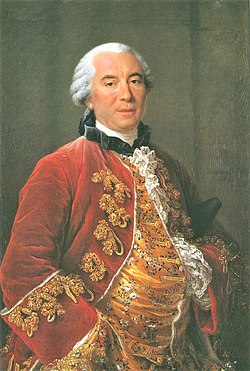 |
| Buffon himself |
If one wants to
investigate the development of biology into its modern shape, one
must surely study the works of Buffon. Including him in a discussion
of philosophy might seem less reasonable, but considering the
importance of Darwin's theory of evolution to a modern way of
thinking and Buffon's value as a step towards Darwin, his inclusion
seems more understandable.
Buffon's main work
is Histoire naturelle, a huge, multivolume study on such
varied topics as cosmology, geology and biology. Going through all of
these volumes would be an arduous task, and so I've chosen to read
only a selection of what should be especially philosophical portions
of Buffon's works. Even in comparison with this selection, my post
will be just a quick summary of some interesting features found in
Buffon's writings.
We might begin from
Buffon's methodological remarks. Buffon sets out himself between what
he considers two faulty extremes. First of these extreme was
symbolised by Aristotle, who according to Buffon had no real method
at all in his biological writings – he just enumerated arbitrary
observations on the behaviour of animals, without trying to make the
observations into a coherent system. The other extreme, on the
contrary, tried to use an artificial, rigid and external
classification for making sense of the living world – Buffon
mentions especially Linné as a representative of this group.
Buffon's own attempt is to find natural classification and
systemification of nature. Of course, one cannot just directly start
from such a classification, but one can still try to proceed toward
such a classification – man-made classifications are only a starting
point, which must be constantly compared with empirical data.
A good example of
Buffon's reliance on empirical data is his attitude towards the
history of Earth. While some of Buffon's contemporaries still tried
to fit Earth's development with the account of Genesis, Buffon wanted
to justify his view of Earth's history more through proper research.
Of course, he still wasn't ready to throw out all of the Bible and
accepted, for instance, the idea of a worldwide deluge. Yet, he
didn't base this idea merely on Bible, but also noted how fossils of
sea animals could be found on dry land.
Fossils were indeed
an important piece of evidence for Buffon, because they show that
animals of previous times have been different than they now are –
elephants of ancient times (mammoths, that is) were considerably
larger than they current counterparts. Buffon still isn't an
evolutionary thinker, but believes that there has been a fixed number
of species since the generation of life on Earth. These species could
have varied in their features and especially they might have
degenerated, like elephants have become smaller – earlier Earth had
more vigour in producing animals, Buffon explains. Still, no truly
new species is ever born. Here he justifies once again his statement
through fossils – all species of current times have been found
from fossil sources.
Although Buffon
believes in the fixedness of certain genera of living things, he does
think there is a certain continuum of life. For instance, he suggests
that there is no clear division between plants and animals, because
certain entities, like corals, share features of both animals and
plants. Somewhat inconsistently, Buffon then insists on a leap from
the level of animals to the level of human beings. While animals are
irrational, human beings are rational, and there cannot be any middle
road between irrationality and rationality. This very traditional
division implies, according to Buffon, that while for animals mere
satisfaction of physical desires is enough, human happiness relies on
harmony between reason and sensuous impulses.
The most intriguing
aspect of Buffon's thought is then how he manages to unify quite
revolutionary ideas with some rather traditional and even
conservative thoughts. Earth and especially its living denizens have
a history, but this history does not entail that all species are
related to one another.Living beings form a
continuum, but humans are still far removed from other species.
As most of Buffon's
works concern rather specific questions of biology and other
particular sciences, I shall leave my account of his work to this rather general level and turn again to American philosophers.
sunnuntai 3. elokuuta 2014
D'Alembert: Traité de dynamique (1743)
Jean
le Rond d'Alembert is a name more often heard in a history of
mathematics than in a history of philosophy. Yet, his connections to
the world of philosophy in French Enlightenment are not non-existent,
because he was one of the editors of the famous Encyclopédie,
an encyclopedia meant to cover all human knowledge of the time.
D'Alembert was particularly entrusted to care for all the articles
engaged with natural sciences, but he also wrote a preliminary
discourse explaining the purpose of the work and also engaging with
some philosophical underpinnings of it and presenting a general
framework for all sciences.

The
book I am engaged with here belongs on the surface to d'Alembert's
more scientific works, as even the name suggests. In effect, the
purpose of d'Alembert in this treatise is, firstly, to present some
fundamental principles for movement of material objects, such as
inertia, and secondly, based on these principles, to solve some
tricky problems, in which, for instance, the velocity of a body
hanging from a thread is to be determined.
The
topic of d'Alembert's treatise is then something that modern students
of physics might find useful to consider. On the other hand,
d'Alembert's method of presenting his result has some quaint
elements, which show his work to belong to a transitional period
between a geometric presentation of Greeks and algebraic presentation
familiar in modern mathematics and physics. This is firstly shown by
d'Alembert's assumption that everyone knows truths that have been
demonstrated by Euclid in his Elements, as he without any
explanation refers to a property of a circle that if two lines AB and
AC are drawn from the same point A outside circle so that AB touches
the circle on B and AC goes through a point D of the circle and then
cuts circle also in the point C, then the square of the side AB
equals a rectangle formed by AD and DC or AD x DC. While a modern
student of mathematics might even have some difficulties following
this description, let alone being convinced of it, any connoisseur of
mathematics from d'Alembert's time would instantly recognise this
statement as the proposition 36 in the third book of Euclid'sElements.
Even
more clearly this transitional nature is seen in d'Alembert's habit
of embodying quantities like velocity, time and others with lines,
which for an eye unused to geometric way of presentation seem to have
no connection with each other, although one acquainted with this
method could see what mathematical relation the different lines are
supposed to exhibit. Then again, in more difficult cases d'Alembert
prefers algebraic denotations of mathematical relation. What makes it
all even more confusing is that while d'Alembert clearly had an
inkling that some quantities (e.g. forces) have a direction, neither
the geometric presentations nor algebraic formulas clearly
distinguish between scalar and vector quantities. Add to all this the
rather muddled view of infinitesimals at the time, in which e.g.
differentials of various levels were represented by lines that are
supposed to be infinitely small, and a modern reader is bound to feel
some puzzlement.
Philosophically
most interesting part of the book is, as is often the case with such
treatises, the preface. Here we find d'Alembert's take on the muddled question of ”living forces”, seemingly physical problem that
still interested such philosophers as Descartes, Leibniz and Kant.
The controversy itself started from the apparently obvious notion that
something remains same in various interactions of bodies, such as
collisions and that this same element would represent the quantity of
motion itself. Descartes, among others, had suggested that this must
be what is nowadays called momentum or mv, in which m
means mass of the bodies involved and v their velocity. Some
people, such as Leibniz, objected that what is conserved is actually
a more intricate quantity, ½(mv^2). Leibniz also asserted that this
quantity expressed a living force of the moving bodies themselves,
while momentum was connected only with dead forces affecting bodies
externally.
D'Alembert
strategy, at least in the first edition of the treatise. is to deny
that there is any true controversy. Momentum is conserved in
momentanous collisions of bodies, while Leibnizian quantity of motion
is conserved in cases where e.g. a medium continuously resists the
movement of a body. Now, the case of a resisting medium can be
regarded as an infinite sum of infinitely small collisions, which
mathematically means that Leibnizian quantity of motion must be an
integral of momentum, as it truly is. Which one to take as the more
essential expression, d'Alembert concludes, is just a verbal quibble.
Although
d'Alembert's solution is, as far as I know, quite correct, it also
expresses a more general tendency of disregarding all philosophical
problems as verbal quibbles – something quite common for modern
scientists. This tendency is shown by d'Alembert also with a question
concerning the status of physical laws : are they necessary or
contingent? D'Alembert attempts once again to show that both sides are
in a sense correct: laws of physics are contingent, because world
could have worked according to different laws, but they are also
necessary, if you take into account the empirical evidence about the
motion of bodies. D'Alembert fails to notice that he has actually
endorsed one side of the dilemma – contingency – and rephrased
the other side, so as to fit with the first side. Furthermore, from a
modern viewpoint, he has accepted a rather strong position . Not many
would accept that empirical data would fit in with just one physical
theory and thus necessitate it.
So
much for d'Alembert, next time another philosopher from French
Enlightenment.
Tilaa:
Blogitekstit (Atom)