I’ve already discussed de Bonald’s ideas about the proper form of state - to summarise, he was a conservative thinker, who preferred hereditary monarchy over democracy, because the former provided a unifying element required for stabilising society and keeping it running according to necessary laws. I am now about to discuss his opinions on the more theoretical side of philosophy and particularly his work Recherches philosophiques sur les premiers objets des connaissances morales.
De Bonald begins his discussion with a summarised account of the history of philosophy, starting with Thales and ending with Kant and his school. While his account is at first quite diverse, he is finally quite willing to divide all philosophy into two rough classes, according to the question of the source of our ideas - those de Bonald calls Platonists, who believed in the possibility of innate ideas, and those he calls Aristotelians, who upheld that all ideas are ultimately derived from sensations. This is strikingly similar to the ideas of Saint-Simon, which makes one suspect that both thinkers relied on some common tradition in French historygraphy of philosophy.
It is no wonder that de Bonald, with his conservative take on philosophy, prefers the platonistic side of the dispute. This can be seen especially in his attitude toward the question of the origin of language. On the one side of the question, de Bonald sees linguistic atheists, who deny any peculiar origin of language and regard human speech as a mere haphazard accident that has arisen through happy circumstances. At the other side, then, are linguistic theists, who insist that skill language has been created together with the creation of human beings, just like the biblical story of Adam naming animals reveals. Finally, there is also the deistic middle stance, which supposes that human language has arisen gradually over time, from a state of complete silence, but also that humans have had a natural tendency for speech, not to be found with other animals.
De Bonald insists that the proper answer to the question is the theistic one, simply because language is something that could not have been invented - invention would have already required thinking, but human beings simply cannot think without the aid of words. A particular target of his criticism is Condorcet’s notion of the development of human culture, which undoubtedly was highly speculative account. Of course, nowadays we would quickly discount de Bonald’s explanation by saying that it is equally speculative, based on mere unverified myths, while the seemingly separate realms of silent animality and linguistic rationality seem in our eyes to be more like two points on an unbroken continuum.
De Bonald goes even further and suggests that even writing is something humans cannot have invented by themselves, pretty much for the same reason as language couldn’t have been invented - to distinguish sounds within words, one must already have letters to indicate them. What might have been invented was hieroglyphical writing, in which all words were indicated by one picture, but like other thinkers of the time had said, such a manner of writing expressed a stagnation of human development. The truly innovative alphabetical writing, de Bonald insists, must have been of divine making. Indeed, its very purpose was to counteract the all too human habit of forgetting such important things as divine law.
On basis of these considerations, it is no wonder that de Bonald is against any materialistic theories of human constitution. He notes as a physiological fact that human brain plays a crucial role in the formation of human consciousness, because all the nerves clearly transmit sensations to it. Yet, he notes, this does not necessarily mean that brain is the source of thoughts, because it might as well be just the means by which the proper source of thinking - intelligence - receives sensations and transmits commands to various parts of the body. Indeed, de Bonald says, the latter theory bears striking resemblance to the proper form of state, in which a monarchic ruler uses noble ministers to guide the body of state.
De Bonald finds three different aspects in the intelligence: imagination, or the faculty of making mental representations corresponding to sense objects, understanding, or the faculty of conceiving ideas of non-sensuous, intellectual objects, and finally, sensibility, or the faculty of sensing pleasure and pain. Now, all of these aspects have their own form of language, de Bonald continues: imagination makes gestures and pictures, understanding creates articulated speech, while sensibility is shown in involuntary movements and cries.
What de Bonald tries to achieve by distinguishing these three faculties is, firstly, to argue against the Condillacian theory that all thoughts are just modifications of sensations. Especially he wants to say that ideas - say, like of justice or goodness - are not mere sensuous images. Of course, we have learned through senses the linguistic expressions, which refer to these ideas, but the ideas themselves must be innate in us, at leas as innate capacities to think such things, de Bonald concludes.
The second reason for this trivision of mental faculties, lies in de Bonald’s wish to undermine the materialistic philosophy of mind presented by Cabanis. While Cabanis had suggested as significant evidence for materialism that such things like age, gender or climate affect one’s mental constitution, de Bonald suggests that such matters affect only things like taste in foods, which belongs more to sensibility, but not ideas, which should be universal. Indeed, de Bonald states, seeming counterexamples of cultures having different moral norms are not dependent on material influences, like climate, but simply on the moral state of the culture in question.
From the rather clear that fact that a person can wish for one’s own death, de Bonald draws the rather strong conclusion that human soul must be immortal. De Bonald’s reasoning is based on the assumption that soul or human personality can never really hope for its own destruction. Indeed, when one desires death, one desires merely separation of soul from the shackles of body, de Bonald says. Of course, one can quite well suspect such a statement, because we might well assume some suicidal people would really want to destroy their very consciousness.
De Bonald also notes the universal recognition of the existence of God. Indeed, he notes this on each of the three aspects of human cognition: different cultures have had images of divinity, they have talked about gods and they have surely had sentiments of the creator. De Bonald suggests this universal recognition as a premiss in a Cartesian proof of God’s existence - if humans have had cognitive stances about God, God must be possible, which means that he must also exist. Yet, as he himself appears to understand, the most convincing argument he could use is more emotional - the universality of belief in God seems hard to explain, unless God really existed. Indeed, de Bonald notes, even hardline materialists cannot but fail to speak of such matters as the order of the world, thus implicitly already assuming the existence of someone to order matter.
It is no wonder that as a conservative thinker de Bonald doesn’t try to introduce any novelties in his philosophy, but defends a tried worldview. Thus, it is to be accepted that after bringing God into the equation, de Bonald notes that he has organised the world teleologically for the sake of human beings. In another analogy with state, de Bonald calls humans ministers of the divine monarch, leading all the other living beings. This does not mean that humans could despotically rule over animals, because they should be more like guardians to animals. Still, de Bonald sees humans as clearly above animals, because animals are, de Bonald says, perfect and cannot become any better, while humans are perfectible.
Näytetään tekstit, joissa on tunniste materialism. Näytä kaikki tekstit
Näytetään tekstit, joissa on tunniste materialism. Näytä kaikki tekstit
sunnuntai 25. helmikuuta 2018

keskiviikko 5. elokuuta 2015
Joseph Priestley (1733 – 1804)
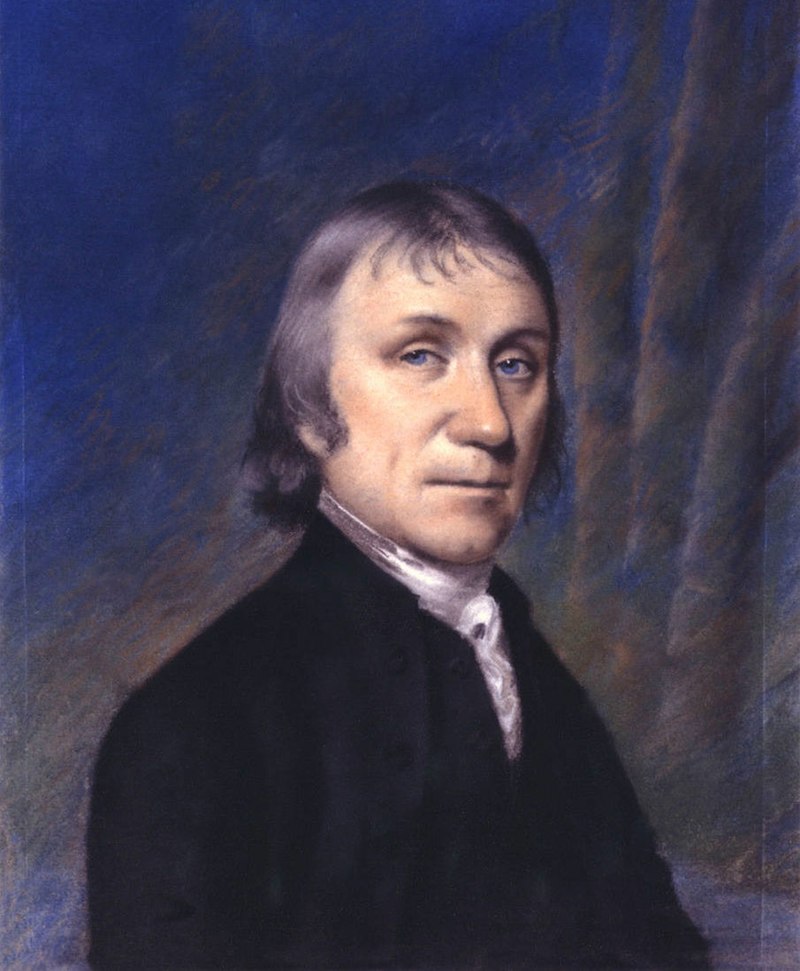
I am once again
tackling a figure whose work lies on the borders of philosophy and
science. I haven't read any one book from him, but instead, I have
investigated a selection, the title of which (Priestley on science,
philosophy and politics) reflects the variety of the thinker's
interests. Because Priestley was also interested of religion, one
might say that he played altogether four different roles.
Starting first from
the role of a scientific investigator, we may note that Priestely is
famous as one of the first people to separate oxygen from air. But
Priestley's discovery is an important indication how different it is
to do an experiment and to interpret it correctly, as he did not
believe he had found a new element – instead, he thought he had
managed to purify air from phlogiston, the element that supposedly
caused all phenomena involving fire. Priestely quickly noted that
this purified air was more invigorating than ordinary air and he also
noted that plants appeared to emanate such air.
In addition to
dabbling with scientific experiments, Priestly was also a historian
of science and worked on an history of electrical studies. Still,
perhaps most interesting work of Priestely on the topic of science
are his plans for systematising scientific research. Priestly
suggests that instead of founding huge societies responsible for all
kinds of scientific study, there should be many small societies
specialised for a small subfield in science and responsible for
collecting funding for that field. In effect, Priestly is suggesting
an idea common these days, that universities should concentrate their
research on their strong areas.
Priestley's
innovative skills were not restricted to mere research politics, but
he was, secondly, an eager political thinker. His model of good
society was clearly based on United States of America, as he was a
stout defender of republicanism and demanded the right of citizens to
have an extended field of action, in which state should have no say
at all – Priestly goes even so far as to suggest that education
should be no business of the state. Furthermore, Priestley speaks
vehemently against any privileged class or nobility, except in case
of such a class serving the needs of state. And while Priestley did
condemn rebellions, he also noted that fight against tyranny was no
true rebellion. In line with Priestley's rather Republican ideal of
society is his insistence that criminals should be punished hardly,
in order to deter anyone from committing a crime. Ironically,
Priestly congratulates USA of not being a colonial power and of
never falling into a civil war – a mere century would have proven
him wrong.
An important part of
Priestley's liberal ideal of state is a demand that all religious
sects should be tolerated. This is an important element in his third
role as religious thinker. Priestley was a unitarian, who thought
that Christ did not have a divine nature. Indeed, his philosophical
views went even farther away from the traditional religious views. For
instance, Priestly denied the possibility of spontaneously working
will, but insisted that all actions require some motive – even the
act of going against a motive is never unmotivated. Somewhat
surprisingly, in addition to basing this thesis on the universal
validity of causal principle, Priestley also uses a religious
argument – God could not foresee things ahead, if the events of the
world would not work in a strictly deterministic manner. Furthermore,
he also notes that morals would not work without complete
determinism, since a randomly acting person could not be improved in
any manner – she could always accidentally act in a completely
different manner.
In addition to being
a determinist, Priestly was also a materialist. Or, to put it better,
he did not believe that there was any wide cleft between material and
spiritual phenomena. Matter was not a plenuum or completely solid,
but must have been full of emptyness, since it e.g. could be a medium
for movement of light. And if matter was really not material in the
brute sense of the word, Priestley argued, why could we not say that
so-called soul is also made of matter?
Tilaa:
Blogitekstit (Atom)