Näytetään tekstit, joissa on tunniste beautiful. Näytä kaikki tekstit

perjantai 12. elokuuta 2022

Christian Hermann Weisse: System of aesthetics (1830)

(1801-1866)
As a specialist on Hegelian philosophy I’ve come to notice that in studying works engaging with Hegel I must distinguish the picture of Hegel presented in these works from what Hegel really said (or more precisely, what is my picture of what Hegel really said, since I cannot be sure I have deciphered Hegel's meaning correctly). Thus, when reading Weisse’s System der Ästhetik, a work expressly indicated as a development and even an improvement of Hegelian philosophy, I had to constantly remind myself that Weisse is speaking not so much of Hegelianism in itself, but of the view he had of it. For instance, Weisse takes as Hegel’s definition of the topic of philosophy, the idea, that it is the eternal and necessary form of all that exists. True, Hegel does say that idea is eternal and necessary, but one might wonder if this is just a description of this “idea” and leaves out some crucial and defining characteristics.

Weisse’s understanding of Hegelian idea is in line with his understanding of the apex of Hegelian philosophy, where all the previous developments are summed up in the very notion of philosophy itself. For Weisse, this is ultimately just a passive, theoretical move, where the philosopher merely grasps the truth of what has been previously exposed, but does not actively engage or do anything with it. One might argue that the Hegelian philosopher as a living, conscious individual is constantly doing just that, but Weisse thinks that there is rift between this viewpoint of a finite individual and the viewpoint of the Hegelian philosopher supposedly knowing the essence of all there is to know.

Weisse insists that this rift must be bridged. Hegel himself might say that the whole of his philosophy is dedicated to bridging this rift and showing how anyone could become a philosopher, but this is another discussion. Weisse, on the other hand, thinks the bridging should be done through something completely different - an idea of beauty surpassing the idea of truth embodied in the Hegelian philosophy. Weisse thinks he is here following Hegel’s dialectic-speculative method and surpassing Hegelianism by its own means.

What is lacking in Weisse’s account is the crucial idea that the outcome of such a move should be based on its very starting point. That is, we shouldn’t just find a supposed inadequacy in the starting point and suggest a way to amend it, but we should be able to transform the very starting point by its own means to the end point. In other words, we should be able to start with a philosopher recognising the truth of philosophy and showing how this very experience can become or at least give rise to an aesthetic experience of beauty. This is a path that one could very well take, since a recognition of a deep and meaningful truth could be described as aesthetic. Still, it is not the path that Weisse takes. On the contrary, he thinks that such a recognition of truth is by itself not capable of being an aesthetic experience, which for him requires something surpassing mere truth.

Beauty is then for Weisse, in terms taken from Hegel’s philosophy, an Aufhebung of truth, that is, it contains truth, but only as one aspect in a greater whole. What this more is that is added to the truth is that beauty appears in the viewpoint of finite individuals, that is, in the ordinary human life. Still, Weisse insists, beauty also presupposes truth, which means for Weisse that aesthetic theories not understanding Hegelian viewpoint will not express the truth of beauty.

Like truth, Weisse says, beauty is still something connected to Geist or life of conscious beings. Here Weisse points to the notion of fantasy (Phantasie), as used by Fichte and romantics. Fantasy, Weisse says, is something different from mere imagination (Einbildungskraft), which means simply our ability to have mental images of things we have perceived, but are not currently perceiving. Fantasy, on the other hand, should be a higher capacity of representing things pertaining to the very nature of consciousness. In other words, fantasy should be a capacity by which we can think of things like beauty as embodied.

Beauty, as fantasised, is then not just a word we understand, but something that we can perceive and feel, Weisse says. In other words, in fantasy we experience beauty as something that is distinct from our consciousness and that makes us feel as being part of something more universal than us as individuals. In comparison, our finite selves feel utterly insignificant. We are here witnessing another dialectical movement, in which consciousness has an experience of beauty and then ascribes this feeling to an object different from itself as the subject. In other words, we have moved from beauty as a subjective experience to a beautiful object conceived as causing this experience.

While the truth of philosophy is something that is infinite in the sense that in it the philosopher knows that philosophy could potentially understand anything coming across, in the experience of beauty this potentiality is in a sense actualised. This does not mean, Weisse explains, that we would experience an infinite amount of beautiful objects all at once, but that we experience more and more beautiful objects, without any limit. Furthermore, it means that no individual beautiful object or any finite sum of them manages to completely satisfy our notion of beauty, but shows only some limited aspects of it.

Each of these beautiful objects, Weisse says, although agreeing with others by awakening the experience of beauty in us, is still unique in its own way. Weisse clarifies that this uniqueness does not mean just that each beautiful object exists at its own specific time and place, but also that beautiful objects differ in their characteristics. Because beautiful objects still are Aufhebung of truth, while truth already contains the essence of everything studied at previous levels of philosophy, they in their turn contain in a sense the whole world in them. In other words, beautiful objects are microcosms. How a whole world could be expressed in a singular object is a mystery that can never be fully explained by philosophy, Weisse thinks.

Each of these beautiful objects must be a real object in our world and not just a figment of imagination, Weisse says. Beauty must be embodied, but this is as far as necessity goes, he continues. In other words, there’s a degree of arbitrariness and almost of a free choice in picking out what we actually experience as beautiful. This picking out involves then a new dialectical movement. The beautiful object is also something more than just beautiful or it has a number of other characteristics. Beauty is then relegated into a level of a property among other properties.

As comparable with other properties of the object, Weisse explains, beauty becomes a quantitative characteristic: a thing can be more or less beautiful, depending on its other characteristics. Still, Weisse adds, beauty differs from other characteristics of a thing by expressing all of the thing and not just a single feature. Weisse describes this relation also by saying that beauty is not part of the appearance of the thing, but its whole appearance. In other words, beauty indicates a complex relation among the other features of the thing - it is their rule, canon or measure for measures. Weisse also emphasises that beauty as a rule or measure cannot be expressed through a simple numeric equation - beauty lies not just in e.g. symmetry. In this sense beauty could also be called irrational, just like irrational numbers cannot be expressed through mere multiplications and divisions.

The canon of beauty ties the disparate realm of beautiful objects into a unified whole, Weisse says. At the same time, it creates some limits to what can be called beautiful, even if these limits cannot be clearly expressed. In other words, by changing the characteristics of beautiful things, we could slowly turn them into something that is not beautiful. I shall study the outcome of this dialectical transition in the next post.

perjantai 6. helmikuuta 2015

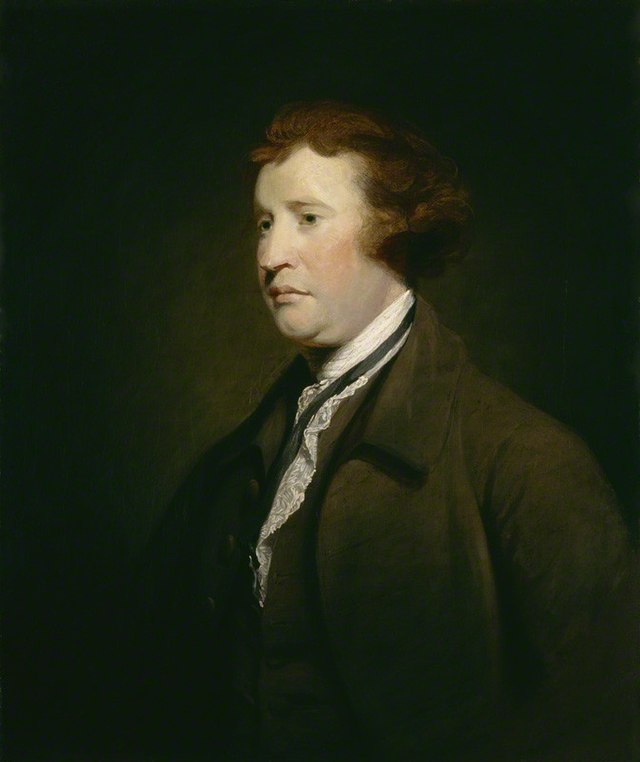
Edmund Burke: A vindication of natural society (1756) and A philosophical enquiry into the origin of our ideas of the sublime and beautiful (1757)


Edmund Burke (1729 – 1797) is probably best known for his work against French Revolution, but before that he also published these two interesting writings. First of these is, at least according to the editorial introduction, a satirical pastiche aimed against Lord Bolingbroke, leading deist of the time. Bolingbroke had argued that original Christianity had been defiled through centuries of convention by all sorts of mystical rituals, which were disastrous to believers and against reason, thus calling for a return to this supposed natural belief. Burke makes an analogical move and argues that by same token civilized societies are artificial and therefore a return to natural state is in order.

Vindication might be satirical, but Burke's argument can be taken quite seriously. The existence of polities and states has meant almost a constant continuation of territorial skirmishes, often leading to total warfare. If Hobbes had thought that commonwealths were founded as an antidote to constant battle, the medicine proved to be even more poisonous, Burke points out.

Even in times of peace, a commonwealth is not a pleasant place to live, Burke continues. If the power lies in the hand of a single individual, freedom of everyone else is subdued under a tyrannical power. The case is not mush better, if the power is given to a small group of aristocrats, because that just means there are more tyrants to subdue everyone. Even democracies are far from pleasant, because the people or rabble can be even more intolerant in its decisions than all tyrants together – besides, rabble usually just follows some demagogue and thus produced just a new tyranny.

These arguments are interesting, because they sound quite similar to what one might expect from, on the one hand, anarchist, on the other hand, libertarian thinkers – states are a form of oppression that artificially divide the world into hostile areas. Of course, one could be more of a Hobbesian and ask whether living in societies has some positive consequences, which would weigh more than the supposed loss of freedom. Another question is whether the supposed natural or original state of humans is not just another artificial construction, which just reflects the mores of our own times.

Second work I shall study is Burke's book on philosophical aesthetics. It was a success at least on the continent, and such German philosophers as Moses Mendehlsson and Immanuel Kant were inspired by his work. Burke's basic attempt in the book is to explain the difference between two aesthetic notions, sublime and beautiful. Of the two, beauty seems a more familiar concept, so I am going to begin with it, although Burke prefers the opposite order.

A common idea of beauty has been that it has something to do with harmony and is thus mathematical in nature, because harmony is defined by numerical proportions. Burke has a bit of fun with the idea, noting that our sense of beauty is immediate and not dependent on taking exact measurements of e.g. limbs of an animal. A related theory of beautiful has connected beauty with fitness or utility, which is often decidable by mathematical proportions (for instance, an animal with limbs quite out of proportion cannot live). But Burke will have none of this. True, we do find quite unhealthy specimens grotesque, but we do also meet often healthy animals and people that we do not think beautiful.

Instead, Burke characterizes beauty through the notion of love, which beautiful things make us feel. Here, love appears to be used not in any Platonic, but in quite sensuous sense. Indeed, when we hear Burke describing smoothness as one type of beauty and read him describing the lure of a beautiful roundness of female breasts, it becomes rather obvious that Burke's love is more like sexual or at least sensual titillation. Quite noteworthy is then that Burke's description of beautiful seem to come from the perspective of a heterosexual male: beautiful thing must be small and weak,just like beautiful women are supposed to be. We might then say that Burke's notion of beauty is quite conservative, but at least open about its bias.

What is remarkable is that Burke allows a variety of different aesthetic notions: in addition to beautiful, we also have sublime. Of course, the notion of sublime is not Burke's own invention, but goes back to Longinus and his work on the topic. Sublime, Burke notes, is not a species of beautiful, but more like it's opposite. While beauty is connected with love, sublimity is connected with fear – it is pleasure caused by great proportions and immeasurable quantities that overwhelm us. While fear itself is not a pleasant feeling, sublime objects can awaken a sort of second order feeling, in which we reflect on our primal sense of fear and discomfort and find pleasure, when we understand and win our fear.

The notion of sublime is interesting, because it widens the realm of aesthetic notions – thing doesn't have to be traditionally pretty to be aesthetically interesting. Indeed, we could raise the question, whether the two notions truly are all the the aesthetic feelings we are capable of. If our sense of beautiful is caused by sensual titillation and our sense of sublime is caused by fearsome awe, could objects and events causing feelings like nausea or boredom cause also similarly aesthetic emotions as happens in case of sublime objects


Burke has still plenty of interest to say about e.g. the aesthetic effect of words (Burke notes that, unlike many modern thinkers had thought, words need not constantly produce images or representations of things they mean, but they can directly cause feelings, for instance, because of constant use – if virtue has been spoken of in suitably solemn occasions, the mere word will rouse that same solemn feeling again). Still, I am going to leave Burke's aesthetic theories here and move on to another philosopher.